The things I know and you don’t

Travel is an incredible thing.  You can learn things you never knew but you have to be in the right place at the right time.  I have always resisted my wife’s desire to be part of a tour.  My idea of travel has been to explore while hers was leave the driving to someone else.  I held to the premise that exploring will uncover those hidden nuggets, accidently while presenting them as pleasant, most of the time, surprises.  The problem is, the odds are you might just as likely discover that you were lost and only thought you knew where you were.  The only surprise turns out to be all the things you missed and without my wife’s method, never even knew you had.  I believe the term is “blissful ignorance.”

Lest you think I am defending my approach, you are wrong.  I have, after several, no, many successful times using with my wife’s methodology, succumbed to the idea that at the very least I need to compromise.  The beauty of my wife’s reliance on tours and tour guides is that I have learned things about an area or region or country that I never would have if I had just been stumbling around in the “explore” method.  And I might add, in such a shorter period that I still had the time to indulge my desire to explore.

This trip across the Netherlands, Germany and Switzerland has provided so many “aha” moments each and every day.  The tours have truly exposed us to the culture and history of the cities and countries we have traversed.  The tour guides have entertained, skipped the lines and cued us in to the history, humor and ethnicity of the tours provided for us.  Each and every time they have left us with personal space to spend exploring with just enough direction to leave us satisfied that we had seen the things that mattered.  Call it the “cliff notes” of Europe’s greatest cities.

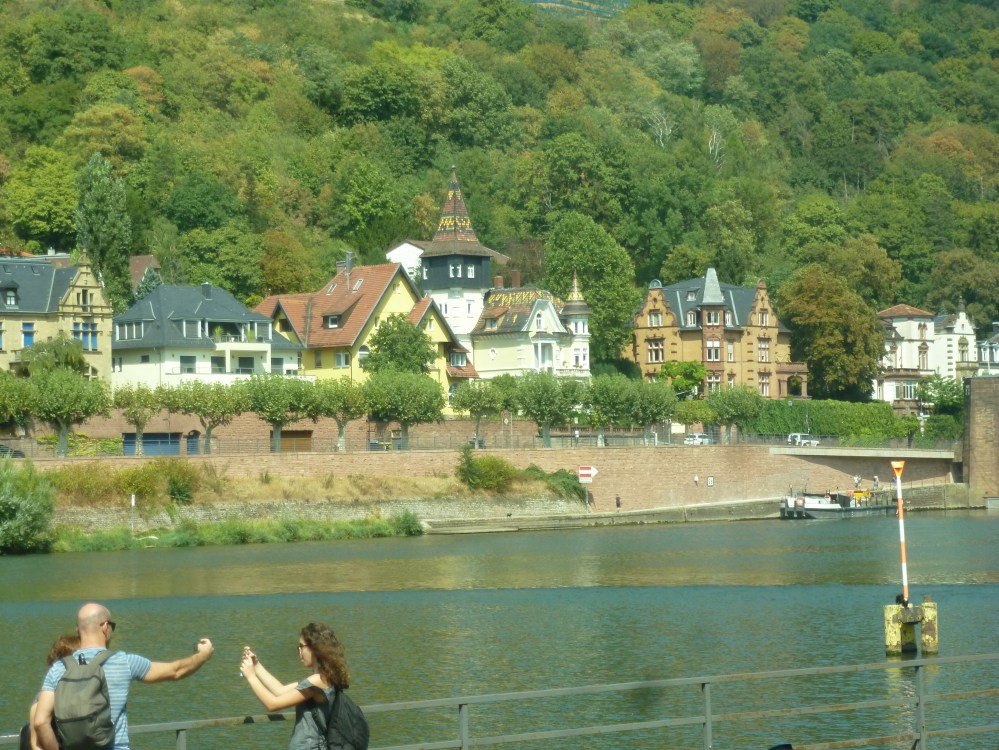
As an example, just today we learned the connection of Professor Bunson, Mr Heinz, Jacob Astor and the Preslin family line to the city we toured.  I found out the origin of Mannheim Steam Roller, the real reason for the success of the Benz Company and the significance of the monkey statue just this side of the Heidelberg Bridge.  And let’s not forget that there were John Deere’s there but they call them Bull Dogs.  And now you are waiting for me to explain these statements………Seriously?  That was the point of this segment.  Unless you travel, unless you take my wife’s advice, you will be stuck with Google.  But I know because I got the chance to be there, to hear the stories and even better, to experience them.

My wish for everyone is that if you haven’t yet, you will one day get the chance to travel to at least a few of the places on your bucket list.  And that if and when you do, you’ll realize that there’s no shame and you are no less the explorer when you take the occasional tour or when you rely on the knowledge and wisdom of the guide.

Life on Board

Transportation comes in many flavors.  The planes have their air lanes.  The auto stays to the highways while the train sticks to its tracks.  Our boat has its river, in this case, The Rhine.  The differences are significant.  While in the air I can only get an idea of what I am seeing far below.  Granted, it does provide a very unique perspective.  The train and the auto, because they are grounded, afford me a view of the surroundings I pass through, but the speed diminishes my ability to take it all in.  The boat, well this is where the difference truly shows itself.

The pace of a boat is flat out slow.  If you are trying to get from point A to point B in any kind of serious time limit, it’s not going to be your first choice.  However, if you really wanted to take in the scenery, then a river boat is a perfect choice.  With its wide vistas and its unobstructed views, the river boat gives you everything year eye can take in as every bend in the river provides a new vista.  The slow and easy pace will lull you into the relaxation your mind and body could never convince you to take.

P1040627.JPG

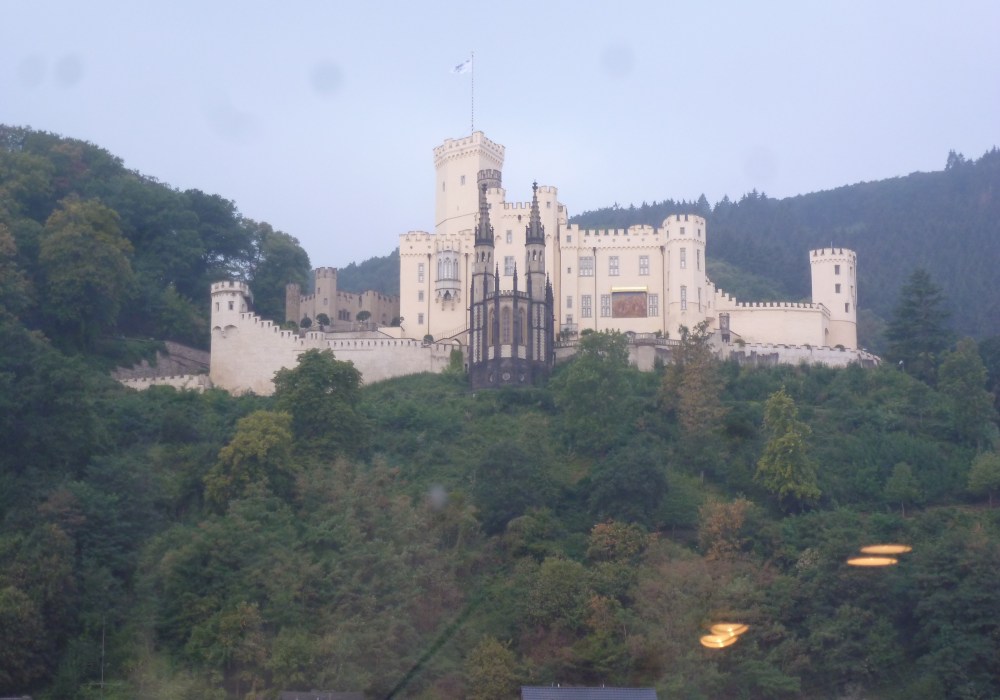
We are four days into our river trip and I thought I would describe life on this boat.  We rise around 7:30, and check the weather and our location by stepping out on our veranda, really try not to take a trip without one.  After reading the daily news summary conveniently delivered to our room, it is down to breakfast.  We can eat inside or take our breakfast on the front sun deck where the views rise to meet us.  Am I sounding like an over privileged, pampered and spoiled tourist yet?  If so, it’s not my fault, for this was the cruise line’s desire to begin with.  Well yeah, I confess.  Later in the morning, we will assemble on the fore deck to depart the boat in search of our guide.  The cruise line has set up an area tour for every day.  If I don’t wish to partake, I can retire to the sun deck or back to our stateroom veranda.  Today, we toured the 800 year old Marksburg Castle.  I may mention that again later.

P1040476.JPG

Afternoon generally finds us sailing to our next site, no fuss, no worries, no work on our part.   We can watch the scenery roll by as the river slides quietly by beneath our boat or take in a discussion or two provided by the entertainment host.  By this time, unless you are a hermit, you will have met ten to twenty new people from multiple states and countries.  If you were diligent, you will perhaps have become travel partners with one or two of the couples you have met.  Recalling the names and places is challenging but everyone is forgiving.  In our case, we have met a couple with many similarities and have been arranging to do activities together.  They are open and warm, interesting and fun.  Who knows, we may stay in touch after the trip, for a moment or a spell or perhaps for a lifetime.  The beauty is, that for now we are travelers in arms.  I teased my wife the first night.  While sitting at the bar, I asked her if we should fish or be bait.  Fishing meant we would go out and seek couples to talk to.  As bait we would sit at the bar and attempt to look interesting.  Which one did we choose?  Maybe a little of both.

Evening on the boat is a mixed bag.  Sometimes, as will happen tonight, we are docked in a port city and we can explore the city center by foot before working our way back to the boat.  Other nights, we will retire to the lounge and listen to some entertainment while locked in conversations ranging from family and kids, to current and past careers, next or past trips and anything in between.  Still other nights, exhausted from our excursions, we may retire to our state room for an early evening or perhaps a moonlit lounge on the open air veranda, watching the river glide beneath us as we head for our next port of call.  No matter what the choice, the day has provided us with sights and experiences that we will not soon forget but that with any luck at all, we will surely repeat.

Got to close, we are off to tour the town of Rudescheim with the goal of finding a cozy place to dine and another chance to lift a toast to tomorrow.

P1040616.JPG


If its Thursday it must be Cologne

After an all-night sail, we arrived in Cologne.  Well, close to Cologne.  There was a medical emergency yesterday afternoon and a gentleman had to be taken off the boat and transported to a Dutch hospital.  Great care was taken by the cruise line and we were later thanked profusely for our understanding of the situation and the delay.  This morning, the cruise line arranged for an early embarkation at an alternate site and transportation by bus to the city of Cologne with a promise to meet us later at the Cologne docks after our day touring the city.

Our tour guide began our tour by explaining just how boring and plain Cologne would be and then proceeded to fascinate us with the history and sites of the city.  A university professor of medieval history with a dry wit and perfectly timed sarcasm, he both educated and entertained us over the next two hours.

Cologne, as we learned, is an ancient Roman outpost for what was then Germania.  The city was completely leveled by Allied bombing raids in World War II meaning that even when buildings looked old, they were in fact no older than that period.  Cologne is a stubborn and traditional city that believes in not changing.  As a result, they rebuilt in the style of the original buildings.  The city was always and still is built on top of the ancient Roman walls.  Cologne’s two main streets lie on the lines of the old Roman Road and their purpose mirrors that of the old Roman city.  The building done on the skeleton of those old walls still divide the new city form the old city inside its Roman footprint.

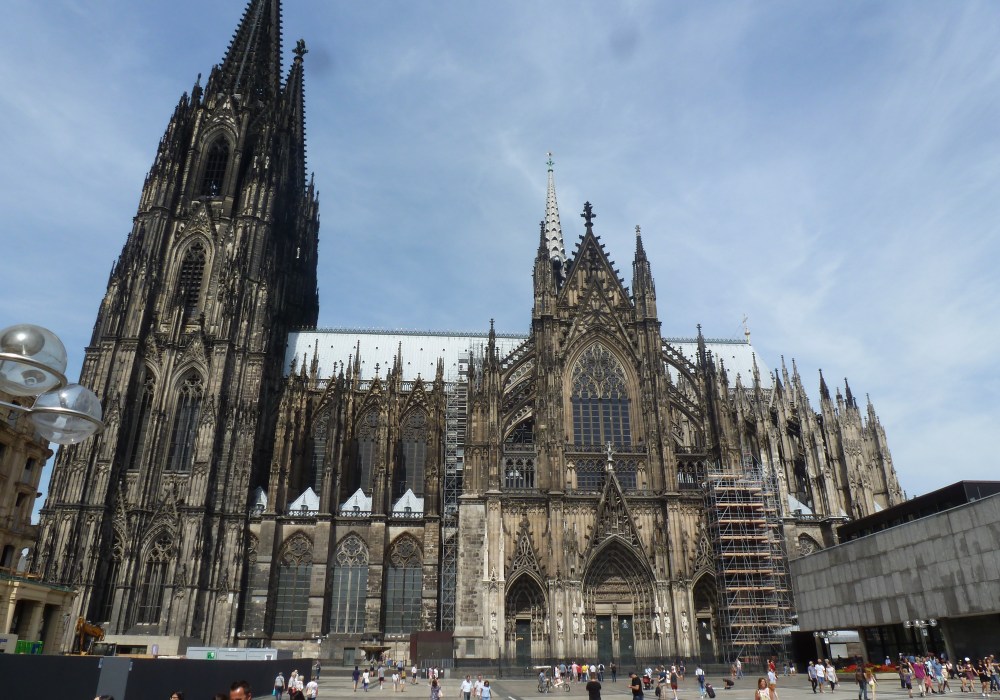
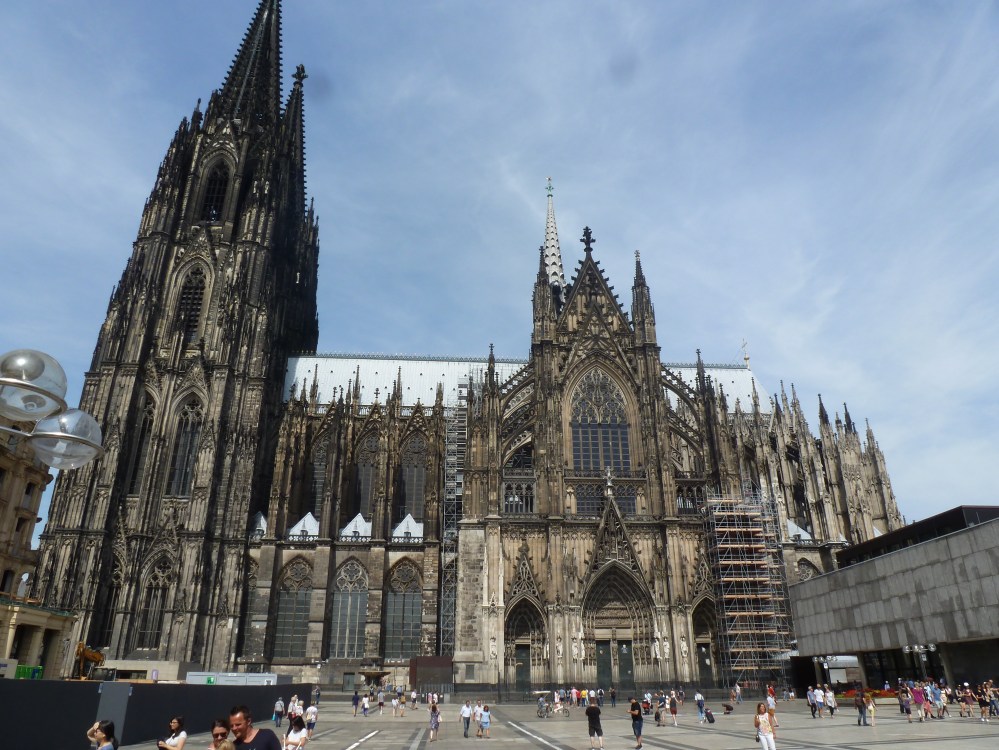
The one very prominent original building is the impressive Gothic Cathedral of Cologne that sits in the city center just up from the old Roman port on the Rhine.  Legend says that it was spared by the Allied bombers while others say it was a miracle and God saved the church.  Our guide watches our expressions and then at just the right time says “sorry, just not true.”  It was bombed just as all other buildings in Cologne, by chance or by accident, and was hit by no less than thirteen separate bombs.  So how does it survive?  The secret lies in the structure.  It is predominately covered with windows and the walls are made of heavy volcanic stone.  As the bomb explodes, its energy is dispersed through the windows while the heavy structure of the walls survive the rest of the blast.

There are so many statistics about this building, including the time it actually took to construct, but I will leave them to you, the reader, to research with a little time spent on Google.  I will share one thought provoking fact.  The windows I spoke of are all original and made of beautiful stain glass.  One even dates to 1248 AD when the cornerstone for the cathedral was first placed.  After telling you that it was the windows absorbing the blast that ultimately saved the cathedral, how can they still exist?  The Nazis as early as 1933, years before the war began, removed the windows and hid them away.  In the words of our guide “they knew early on, that what they were doing was going to end in a serious thrashing and took the precaution to save the windows in case they won.”  Talk about giving one serious pause.

We finished our day in Cologne with new found friends, sharing a local brew or two, or maybe even three, in one of the open market areas of Cologne.  Our toasts were genuine.  “To good travel, to a great adventure and to new friends.”  This is what travel is about and why it is so important to experience.  Travel shows us the diversity of the world and its cultures while reminding us that enemies can become allies and that at the end of the day, we really aren’t that different.  We are all travelers going somewhere and when our paths cross we discover that our hopes and dreams sound amazingly similar.

Castles tomorrow.  Stay tuned.

Tilting at Windmills

I am comfortably ensconced on the good ship Ingvi of the Viking Fleet.  We have a reasonably sized, open veranda room on the top deck.  It is nearing the end of day two and we are sailing toward Cologne tonight.  Tomorrow morning we will awake to the portion of the Rhine running through Germany.  We have been told that in the upcoming days, our boat will be passing by over forty castles located up ahead in the Rhine Gorge.  But today was about windmills and their role in the history of the Netherlands.

P1040436

Marksburg Castle

Before our day’s outing, we were briefed on the history of the Netherlands.  The name itself means “low lands” and the costal third of the country holds 85% of the population on land that is up to three meters below sea level.  So why would people live in an area that would be so difficult and expensive to keep dry?  The reason is simple, the land is fertile and the coast provides the base for their trading.  The end result is that the people of the Netherlands are pioneers in the art of water management.  They raise the water the nearly ten feet necessary to move it into the rivers that drain the area leaving behind the rich fertile land that is now dry land.

P1040327

As you can guess, this is a major task requiring ingenuity at every step.  The water must be sent out and the sea must be kept from coming in.  Early on, the water needed to rise around three feet, but due to further sinking of the land (see the effect of peat farming), the height required, increased.  The solution was found in windmills.  The windmills, set in a series, were able to gradually step the water up the ten feet needed to drop it into the rivers.

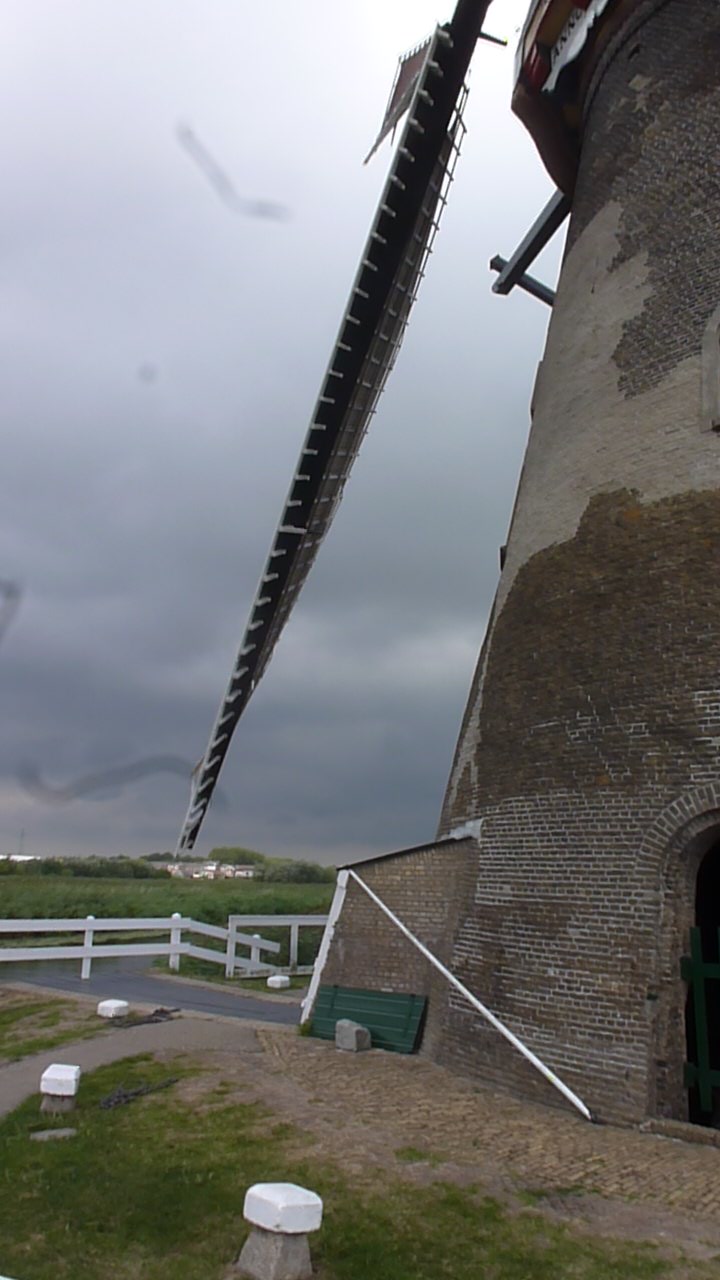
The windmills, still in operation today, date back to the 1700’s.  We were allowed to enter a working demonstration windmill, climb to its very top cap and witness the huge wooden gears working the pumps located in the base.  The woosh of the four huge sails was incredible.  To our surprise, we were told they were only turning at about one-third of their maximum speed.  Even at this speed, the thought of being hit by them as they turned less than a foot from the ground, kept spectators well behind the barrier gates set up to keep us a safe distance back.

P1040349


When inspecting these behmouths, you are first awed by their sheer size, afterall, the miller and his family would live inside the windmill.  When you realized that all of their inner workings were hand made of wood and that they are still running after nearly three hundred years, you are struck by the workmanship.  It was explained simply as “without the windmill, there would have been no Netherlands to inhabit.”

Today has been another day of reality intercepting perception.  I have an improved understanding of why the Netherlands exist and a renewed respect for the farmers turned civil engineers who invented and continue to improve water management.  They are proof that necessity is the mother of invention.

Day two on the river is coming to an end as I type this blog.  Tonight I will sit out on our veranda and listen to the river roll by as our boat sails its waters.  Later I will retire to the vibration of her engines and the gentle rocking of the waters as they slide by beneath us.  Tomorrow we explore Cologne and I can’t wait to record my next experiences.

P1040395

Cathedral of Cologne circa 1248 AD


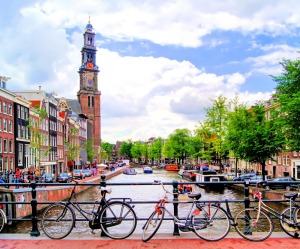
Impressions of Amsterdam… or how I so wanted to be Dutch

This is my fourth entry.  If you missed the other three and want to catch up, go to http://www.kenismsblog.com and look for the “Journey Begins”, “Somewhere over Ireland”, and “A little History and a little Beer”.

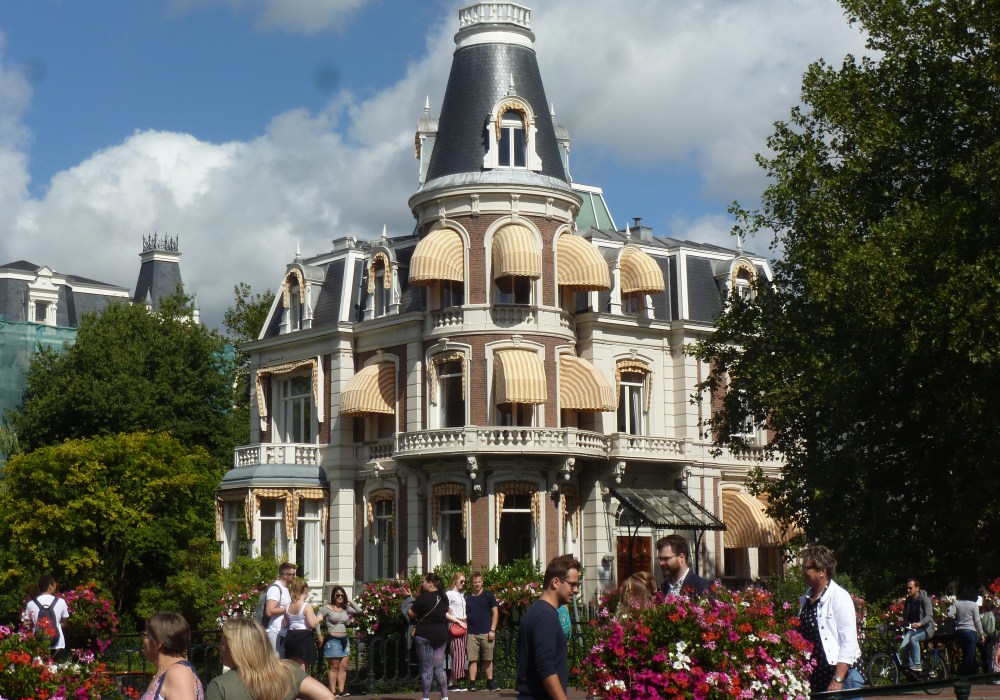
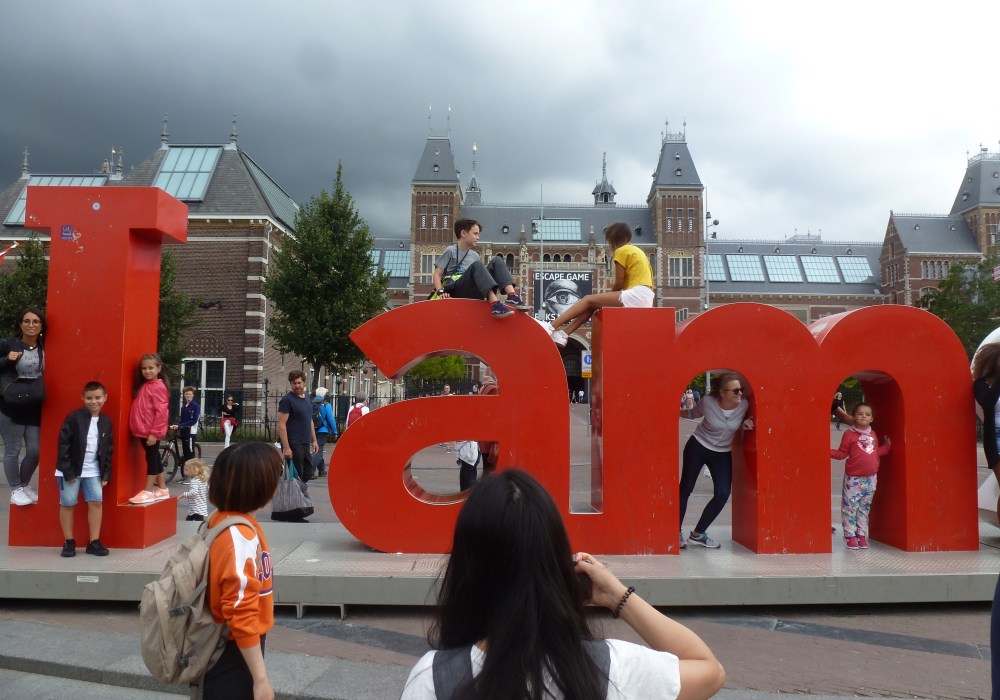
I just finished my third day in Amsterdam and felt it appropriate to give a summary, caution…. I didn’t say it would be brief.  Many things about the city stuck out for me.  It is ironic that I grew up in a small town that was mostly Dutch descendants but it took me until day three to put that in perspective when I saw a familar name on a boat slip.

Enough about reminiscing.  In no particular order, these are the five things that most impressed me or at least left my opinion changed…. canals, bikes, trams, pulleys and the red light district.

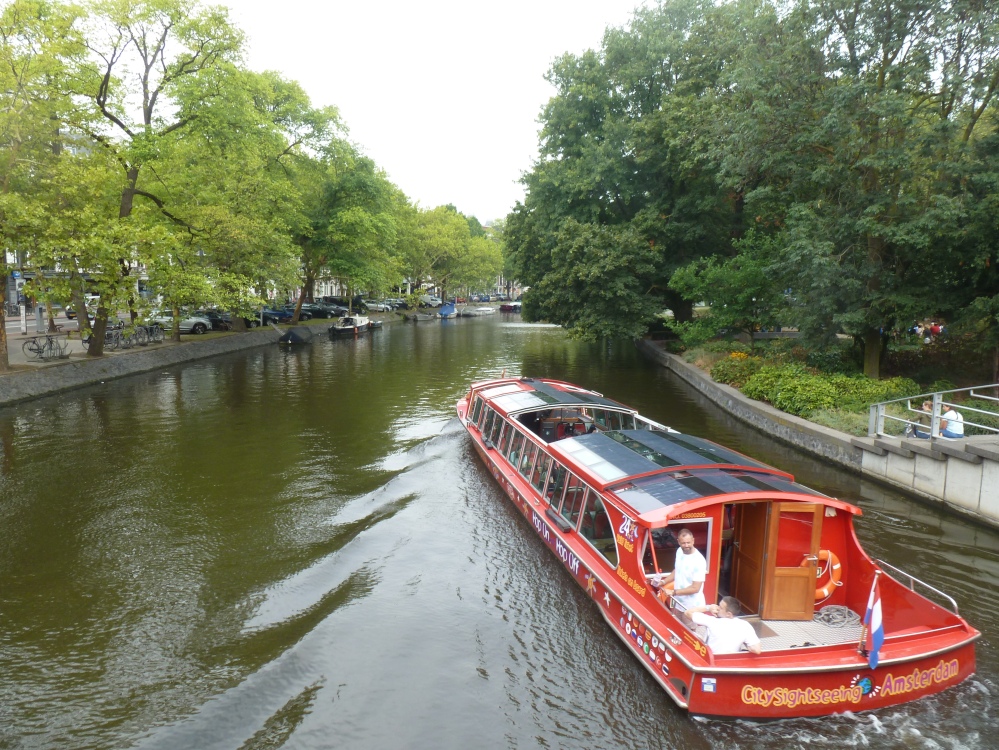
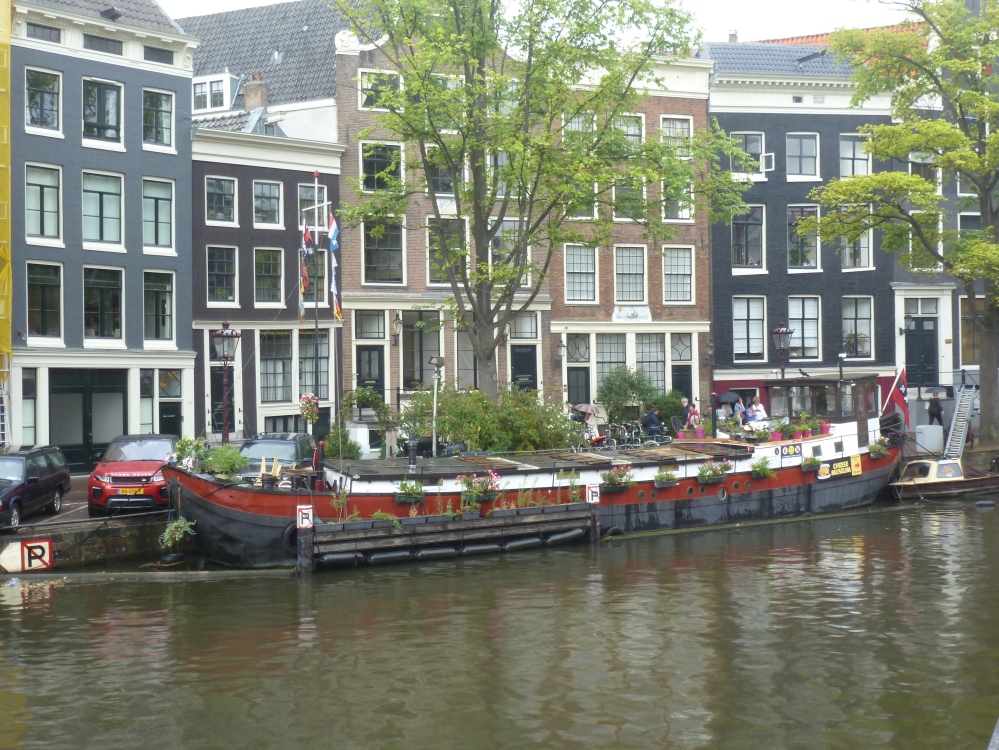
Canals are laid out like beltlines in Amsterdam and they not only provide an alternate transportation system, they drain the city, divide the city into neighborhoods and provide a landmark for navigating through the city.  They flow gracefully as they surround the city and provide dock sites for countless houseboats.  The tour boats ply their waterways all day and into the evening, giving all who climb onboard a very different view and a unique perspective on the city.

P1040217

As you navigate the city and especially its canals, you will notice pulleys protruding from the upper eaves of almost every building.  They look perfectly part of the architecture but are utilitarian in purpose.  Taxes assessed against buildings in the city were originally based on the frontage of the building.  As a result, the locals reduced their tax liability by building their houses perpendicular to the street they faced.  This reduced their taxable frontage but meant the buildings were extremely narrow, often no more than ten to twelve feet.  This adaptation left them too narrow to move anything of size into the building much less up to the upper floors.  The solution was pulleys.  The pulleys allowed the tenants to simple hoist their furniture and goods up to and through the windows.  The effect is impressive.  Some buildings, built very close to the canal bank, would go so far as to slant the upper floors out over the street below to further advantage the canals.

P1040245

One feature of Amsterdam that stood out for me was the trams.  I have been to cities with tram systems, but Amsterdam takes it very seriously.  The trams run everywhere and on time and timely.  I never had to wait more than ten minutes nor did I have to work very hard on what tram I needed to board.  To make life even better, the passes are inexpensive and so easy to use.  Scan in, scan out.  Jump on, jump off.  Now I admit we scanned out improperly one night causing the system to think we had ridden all night, but after a slight inconvenience, a stop at the conductor’s desk, we were back on track, no pun intended.  Next time I am sitting in a line of semi-parked cars on our beltline, I will be thinking longingly of what I can only wish we had.  Thank you Amsterdam.  You gave me every opportunity to explore your city.


It would seem a glaring ommission if I were to skip over the red light district.  Afterall, it is likely the first thing you thought of when Amsterdam was mentioned.  I am happy to tell you it exists.  It is a business but it is not quite as visible as your imgination might project.  It is in fact, well marked and yet hard to actually find.  As you wind through the streets and alleyways of “old town”, you find yourself craning your neck looking at every window for a glimpse.  At best you will find the occassional bikini clad mistress in one of the windows.  The red light district is historic in nature and actually meant to keep the city cleaner and the business ironically less obtrusive.  The Dutch were traders and Amsterdam was their base.  As such, there were plenty of sailors and traders to make prostituion a very profitable endevour.  Without the control of the red light district, the confrontation would be much more…well confrontational.  The red light district provided control of the taxes and the location.  Did I go looking for the district, of course I did.  But then everyone does.  It’s just history you see and pretty much required.

amsterdam-red-light-district


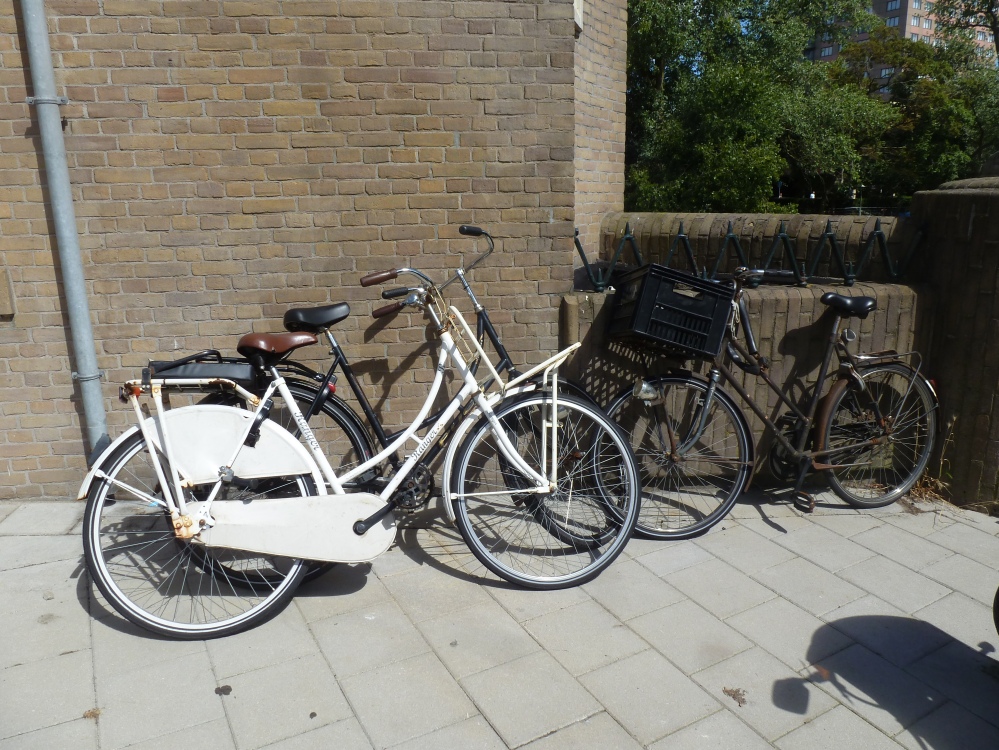
I have saved the best for last, the bikes.  I can only try to do this topic justice.  There are, at best estimate, over 600,000 bikes in Amsterdam.  Considering the population is 900,000….well, pretty impressive.  I suspect that World War Two had a lot to do with it’s growth, the flat landscape and attention to bike lanes only add to the attractiveness of this mode of transportation.


The numbers are one thing.  I knew, because everyone told me, that there were going to be bikes everywhere.  But it is so much more.  In America we ride fancy bikes, often ten speeds at the very least, hunched over our handlebars and attempting to see how far and how fast we can ride.  Some might use their bikes to get somewhere, but most of us just ride to ride.

In Amsterdam it is all about the transportation.  The first striking difference is the bike itself.

P1040298

They are utilitarian in design, three speed at best, with straight handlebars, up high where you can ride erect, eyes on the road ahead.  The bikes almost look old fashioned with their cargo boxes, child seats and saddlebags attached.  But the effect is so different.  Bike riders ride, no, glide by effortlessly, easily keeping pace with the cars, buses and trams that travel one lane over.  This creates a slight problem for the uneducated in that they own those bike lanes and the pedestrian must be ever vigil.  I had been warned about that and had envisioned the American version of a speeding biker, finger erect, letting me know I had invaded their sacred space.  But it was so different.  They owned the bike lane, even earned it with their elegant simplicity, but it was just the gentle jingle of their bike bells that you would ever hear.  Two days in, I was getting accustomed to their prescence and had come to respect their right to the lane.  Afterall, they were going somewhere, be it to work, the market or to some other event that they would arrive at without any addition to the carbon footprint.  Just tire tracks left quietly by human effort alone.


There is really no way to fully describe Amsterdam.  I and other travelers can tell you our stories but in truth, you will just have to experience it.  I hope that you will one day get the chance and I truly hope you won’t miss the opportunity.

It is almost midnight here and the river boat I am on, the Viking Ingvi, has just left the pier.  Tomorrow I get to expand my exploration as we head up the Rhine to new sights and new opportunities.  I hope you will keep following me, but until the next edition, I am off.

A little history, a little beer

Today has been a lot about understanding the history and the culture of Amsterdam.  The history was part of a walking tour but also included a visit to the Anne Frank House.

We read of the atrocities visited on the Jews by the Nazis in World War Two, but we can’t begin to fathom the unbelievable inhumane nature of it until you face the reality physically.  The story unfolds before you as you walk through the secret passageway of the hidden annex.  It is striking in the sacred aura of its cramped areas and the desparate mood of forebodding that still saturates the visitor’s senses.  As you listen to her story, read to you from the pages of her diary, you cannot help but feel both pity and anger.  I left with a heighten sense of anger towards any that would still today support the Nazi beliefs or simply try to deny that this period in time and the crimes committed ever existed.

P1040219

Monument to the Resistence

Going back to the history walk, I found it interesting when the guide mentioned that  ironically, while the Dutch suffered so severely by the Nazi occupation and slaughter of the Jews, her own country was guilty of atrocities against Indonesians as part of their world colonization.  She went on to remind us of their involvement in the slave trade.  As I listened to this confession, I thought of our own history of slavery and our inhumane treatment of an entire race of human beings.  Every country seems to have its period in history that we can chose to bury or remember so as to never repeat it.

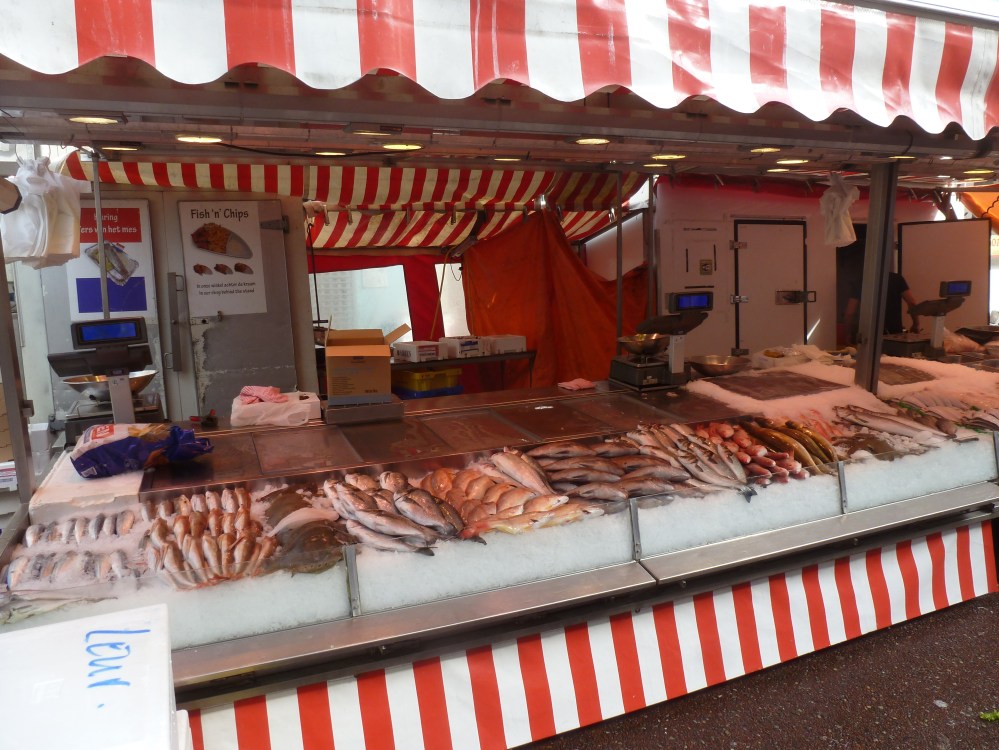
Lest you are thinking this was a dark day, it really wasn’t.  We saw marvelous architecture and art, visited the public market and learned fascinating pieces of Dutch history.  Fun fact, we forget that it was the Dutch who gave us New Amsterdam.  Ceding it to the British changed its name to the one we recognize, New York.

P1040212

A Taste of the Public Market

P1040245

Deb always said she wanted a house on the water?

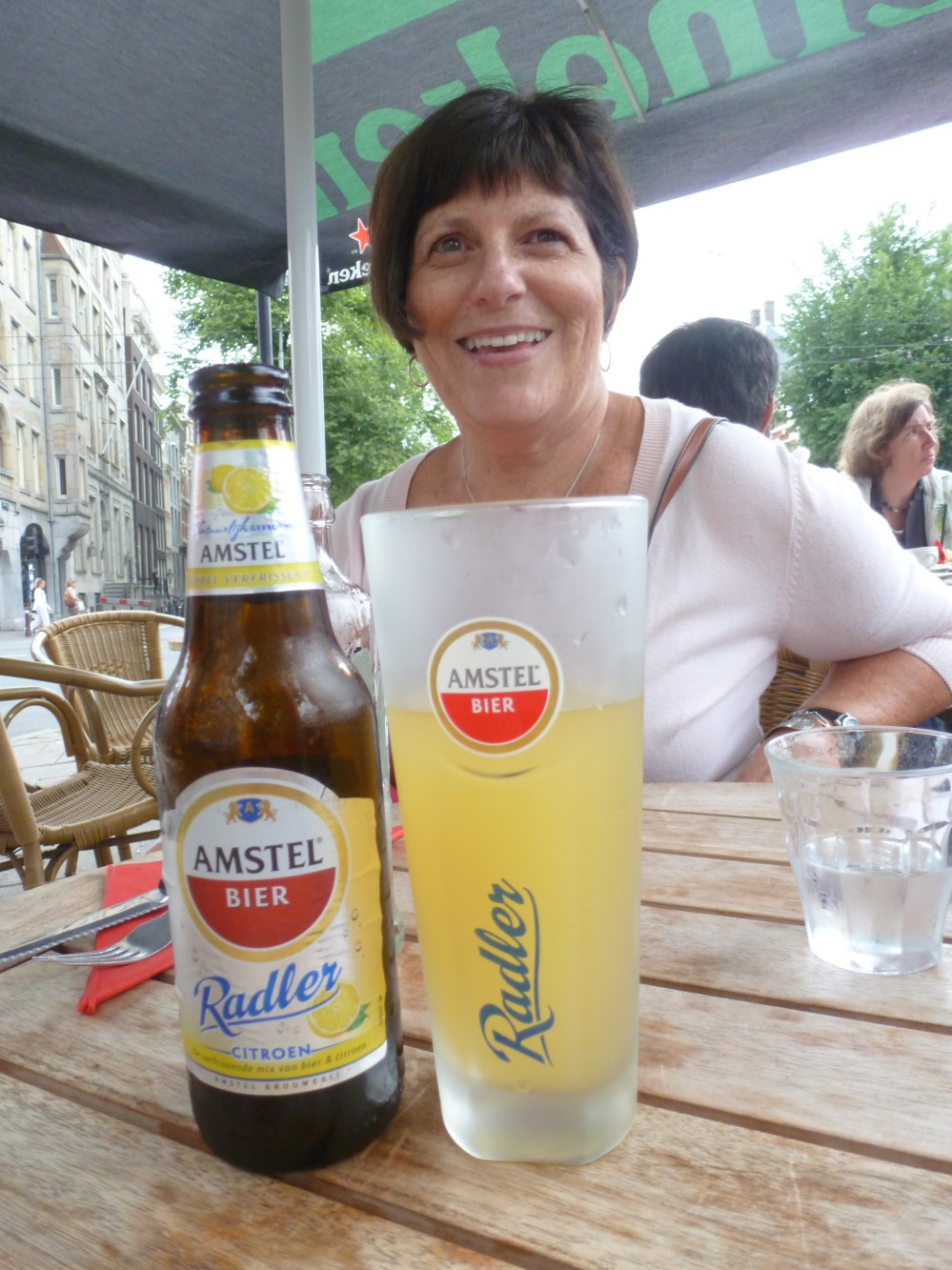
I promised you a little bit of beer as well.  The Dutch will tell you that they do not really have a unique cuisine, unless you count their frites, but rather offer flavors from all over the world.  This is part of their heritage as the market traders of the world, see Dutch History 101.  To that end, I decided I would be sure to explore their selection of beers.  Last night was Heineken and today it was Amstel.  I still have Stella Artois to go, likely tonight, and then I will have savored the known Dutch offerings.  Well not so fast.  Remember, I said I would try to be on the other side of the camera lens.  After a discussion or two or three with locals, it became clear that all three beers are really just tourist choices.  In one of those conversations, I was given a list of craft beers, mostly unpronouncable, that one MUST try.  There is a lesson here for the traveler.  When you stay close to the city centers, you will be offered the tourist fare.  It is only when you venture farther out that you will begin to savor the true tastes and flavors of the culture.  Strike up a conversation, learn a few words and terms, seek out the tucked away spots and you will begin to feel less the tourist and more the visitor.  Try hard enough and you may even begin to feel like a citizen.

P1040244

Debi Does Amstel

But now the night beckons and we must go explore.

Somewhere over Ireland

We have been flying all night, which is a relative term.  While my watch says it is 5:00 am, the outside tells me it is much later.  Seven hours later to be exact.  It is a strange sensation, especially if it is the first time one has ever done it, to fly east, racing toward the sunrise.  The airlines, Delta in our case, does everything possible to help you through this body clock dilemma.  You are served dinner at 11:00 pm, lights and all noise dimmed, eye shades handed out along with blankets and pillows all to get you ready for the big time shift that awaits you.

I walk through the plane several times during the wee hours of the morning, enviously watching the seasoned travelers actually sleeping.  But sleep eludes me.  Though the seats are “comfort seats” designed for extra leg room, my legs will not let me sleep.  They twitch and remind me that I am sitting up when they want to be stretched out parallel to gravity.  The night passes and then at roughly 1:00 am, my time when I should be sound asleep, the plane catches up with the sunrise and reality sets in, you have reached tomorrow, today.

The plane comes awake at 4:30 am.  By this I mean that the lights are slowly brought up and breakfast sounds are coming from the galley.  At 5:00 am we are having breakfast, while miles below, somewhere over the coast of Ireland, they are sitting down to lunch.  As we are landing soon, my body will just have to adapt if this adventure is to begin.  It has been twenty-four hours since I got up in my bedroom thousands of miles behind us.  The world has shrunk and we aren’t in Kansas anymore.

Next stop, Amsterdam, with its canals, windmills and bikes…..hundreds and hundreds of bikes.

Amsterdam

The Journey Awaits

We are sitting in the Minneapolis airport tonight, eagerly anticipating our eight hour trip to Amsterdam.  It is mind boggling how small the world has become and how globally we have all evolved.  An ocean between continents is a mere pond jump in today’s travel times.

We have anticipated this trip for six months and yet it was just not real until my younger daughter deposited us at the airport and admonished us, as grown daughters are now entitled, to stay out of trouble, be safe and enjoy ourselves.  We will be in Europe tomorrow morning, sometime.  I say this because while my wife laid out all the plans, I stayed blissfully unaware of the details.  In fact just the other day when asked where we were flying through, my response was “the air?”  After several days exploring Amsterdam, we will hopefully board our boat for a tour down the Rhine River.  I say hopefully for we were warned just yesterday that due to low water levels our boat ride may become a bus or train ride.  We remain hopeful but are also steeled to make the best of whatever awaits.

Adela out to sea

Hopefully not our Captain…..or our boat.

So Europe awaits.  Castles, mountains and cities older than any of our time frames in America will unfold before us.  My goal will be to document the sites and scenes and to mingle with the people we meet along the way.  My daughter, Kathryn, told me some time ago that the secret was to be in front of the camera and not behind it.  The tourist sees only what is presented to them but the traveler experiences the people and their culture.  When tomorrow finally arrives, I want to be in front of the camera.

Now if we could just get a plane in our gate.

Stay tuned.

Boys and Their Tools

I have a theory, untested but highly probable, that men create projects just to get a new tool.  I am writing from experience in this area.  My garage is a virtual Home Depot East.  Back when I bought my first home, it was simple projects that required reasonable tools.  The occasional screw that needed tightening definitely required a power drill and bits.  The ceiling fan….a volt meter and stripping tool.  You can see where this is going.  Next thing you know, I needed to build a deck.  Two more power drills, just in case I had a helper and a power saw.  My tool collection was building, saw horses, wrenches, wood clamps (not sure when I needed those) and the list grew.  But these were penny ante tools.  I was beginning to lust for the big stuff.

Soon things took a shift.  Up to this point the project had created the tool but if I needed bigger toys, I mean tools…… then I would need to create projects that fit the tool I wanted.  Time to build a cabinet, well actually a play cupboard for my daughter.  This clearly required a miter saw and why just stop there when a Shopsmith provided so much more.  My wife was starting to resist but I wore her down.  The Shopsmith now took up a large portion of our then basement.  But that too would change as new tools required more creative projects.

I think the next step was the need to go cordless.  It was a simple argument to convince my wife how dangerous and inefficient all those cords were.  It started with the drills, worked its way through the power saw and then into the jigsaw and recipricol saw.  Did I mention I found a need for a recipricol saw?  No good toolman should be without that handy gadget.  Eventually my lawn trimmer and my leaf blower (who doesn’t need that when sweeping seems sooooo slow) were soon freed of their cords.

By this time the process was so well oiled, that the minute my wife asked for something fixed or built, she would follow up the request with “and what new tool will this require?”  My daughters, now grown and in their own homes, knew the routine as well.  They would tell me what they needed built and in the same breath tell me they had done the research and I would clearly need this fancy new tool.  This got so bad that at one point, upon going out to pick up yet another unique drill bit, I convinced myself it was time for a REAL tool box.  My twelve drawer chest of wonderment now occupies a proud corner of the garage.  Did I mention that we ran out of room in the basement for my tools?

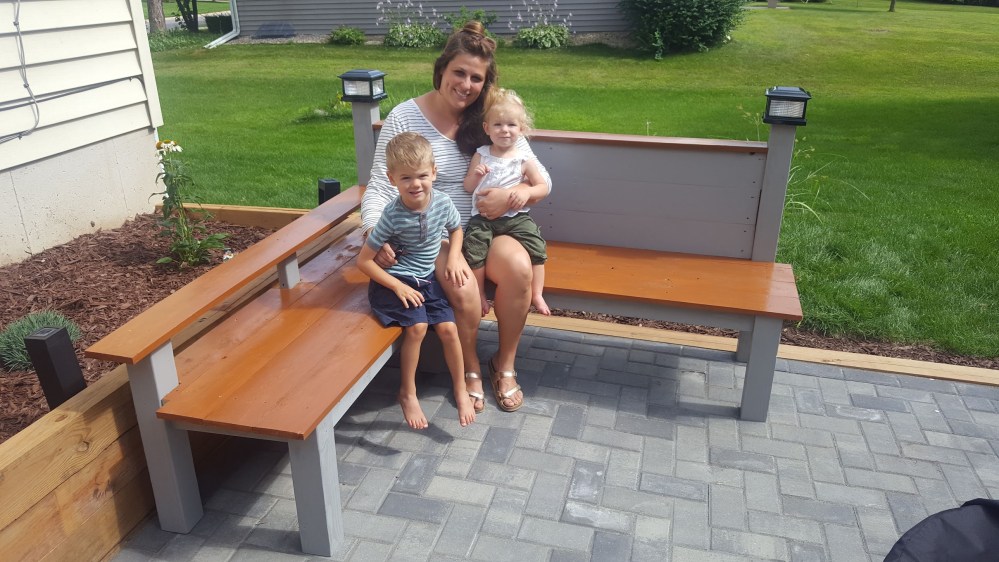
My latest project involved a bench for my daughter and son-in-law’s new patio.  She knew just how to get me to build it.  She first mentioned how much she loved me (that always works) and then followed up with “Remember that Kreg Jig you wanted?  Well guess what this bench requires, hidden screws.”  I could barely contain my pride and my excitement.  New project and a really cool, new tool.

Patio Bench

So my point.  Boys love their tools.  Given a complicated tool, they will not only figure out what to use it on, they will even try to master its use.  And beware, tools are the primary target of “bigger is better”.  Tim the Toolman Taylor knew that and every week we were reminded of the grace and beauty of power tools.  “Arruuhhhhhhhh”

So I am working of my next tool, I mean project, and I am pretty sure there will be some required transportation of the finished project.  And so, I currently have my eye on a nice one ton, eighteen foot cargo van.  And it doesn’t even need a cord.

It Seemed Like a Good Idea at the Time

I was recently visiting the Cave of the Mounds in Blue Mounds, Wisconsin when I passed a young father toting his child in a tag along behind his bike.  The memory from my own attempt so long ago came flooding back to me.

It had been decided that my wife needed a quiet weekend all to herself.  She would catch up on reading and tending her flower gardens while I would wisk the children off for an adventure.  Quiet time is not generally a standard for the parents of two small children.  I had had my boy’s weekend and now it was her turn.

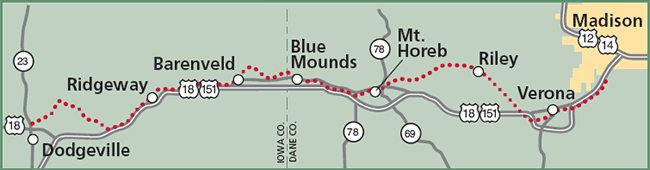
I decided that I would load the tent and sleeping bags unto my bike and tag along, get Bailey, my ten year old, settled on her bike and Kathryn, my three year old, strapped into the tag along.  The weather forcast for the weekend was sunny and reasonably warm and there was a well groomed trail that wound its way from Verona to Blue Mounds State Park where a campsight would be waiting.  It seemed like a good idea at the time.
We all kissed mom goodbye as she dropped us at the trail head and began our ride of some sixteen miles.  I had often easily covered this distance riding the trails in Madison.  In my mind, this should be an easy ride and a wonderful adventure to be shared with my daughters.  And so, we were off.

We had gone about six miles when we passed Riley’s Tavern.  First sign of trouble ahead, both girls needed a potty break.  The looks I received as we entered the tavern should have been my warning.  Oh there was no threat from the patrons, the women of the crowd were actually supportive, cooing and fawning over my daughters.  On the other hand, the men in attendance offered more of the “what are you thinking” variety of looks.  After a potty break and a couple of sodas, we were back on our way.  Well sort of.  Less than a hundred yards down the trail, Bailey took what would be the first of her many career Riley’s Tavern wipeouts.  Before I knew it, she was down on her knees in the gravel, tears flowing in competition with the blood from the scrap on her knee.

I was not going to let this stop us.  A minor setback, I thought, as we returned to the tavern for some first aid.  Our friendly female bartender cleaned the cut, bandaged her up and encouraged her with a popsicle to continue on.  Meanwhile, the men of the bar, looked on with that “told you so” look.  Now for better or worse, this was pre-cellphone era, so mom was none the wiser for our mishap, not that I believed for a minute she wasn’t going to find out.  But I could face that later.  Our planned early afternoon arrival at the camp site was now looking more like mid afternoon, but we were back on the trail.

We had been enjoying a fairly flat to almost downhill trail to this point.  Anything that goes up must eventually go down or in our case, just the opposite.  Shortly after our luxury rest stop, it did.  As the trail continued up, doubt began creeping into my mind.  Bailey’s progress had slowed considerably and with it mine and Kathryn’s.  We started a process that would become Bailey’s biking tradition.  Just as she would begin to ask the inevitable “how much farther?”, we would begin to sing her favorite song, “Denise Denise”.  I find it ironic, that all these years later, her daycare provider is…..you guessed it, Denise.  We were well into the thousandth repeatition of the song, when finally, the trail turned downhill and we coasted into Mt Horeb.

It was at this point the biking gods turned on me.  Not only did Bailey think this was our destination and wanted to be done, Kathryn, who had been sleeping for the last hour, woke up.  She was having nothing to do with continuing this trek and wanted out of the tag along.  To make matters worse, the trail now started to rise again.  In that moment, it dawned on me that you can’t call it a mound if it isn’t higher than pretty much everything around you.  So close, and yet seemingly so far.

I somehow managed to get Bailey going and asked her to not encourage her sisters complaining screams emanating from the tag along, but to actually try to ignore them.  We would be there soon I said, knowing full well that I was now destroying my daughter’s ability to ever estimate distances with any degree of accuracy.  What was a dad suppossed to do?  We entered the desperation phase of our adventure.  Just as I was beginning to feel the weight of the tag along pulling backward as I was struggling up and onward, I needed to start pushing Bailey along with my hand on her back.  I was now riding for three.

Somehow, we managed to continue on.  Kathryn was still crying but she was losing volume.  Meanwhile, Bailey was picking up where Kathryn was leaving off.  She had given up believing my “were almost there” pleas and was now beginning to doubt everything I had ever taught her.  And then suddenly, the sign appears.  It promisingly provides salvation, “Blue Mounds State Park Entrance”.  We made it……….. I’m just kidding.  The park entrance is at the bottom of the mound.  The road meanders up forever and we have been defeated.

After what seems like an eternity, we have managed to walk to the campground office, Bailey walking and me pushing my bike, the tag along and in the only hand left, Bailey’s bike.  Early afternoon long ago became mid afternoon which gave way to late afternoon only to become early evening.  We may have set a record for the slowest bicycle trek. They will compare our speed record to failed attempts for years to come.

I am exhausted, starving and humbled.  I have just enough strength left to pitch the tent and ample fear for what will I do all day tomorrow, assuming we live through the night.  I need a miracle and it happens.  It arrives in the form of the park ranger, a middle aged women who upon checking us in at the office takes much needed pity on me.  Expecting to be admonished for my misadventure, she instead lauds my courage and offers to help.  As I am pitching our tent, she shows up with an arm full of wood for a campfire and the most delicious, life saving frozen pizza ever.  After lighting the fire and inhaling the pizza, I am actually thinking we may survive.

I’m just kidding, what always happens when I try to camp happens…..rain, accompanied by thunder and lightening of course.  Why not?  Morning dawns bright and promising.  What is to be day two of our three day adventure is unanimously voted our last.  We throw everything into the tag along, strap Kathryn in, mount our bikes and make our hasty retreat.  What was our gruelling uphill yesterday is now wonderfully downhill to Mt Horeb and we thank the bike gods for that.  We stop at the first establishment serving breakfast, call mom and capitulate.  PLEASE, come get us, I was an idiot.  But it seemed like a good idea at the time.