Please understand, I am a grown man who has been around the block a few times, many times in fact. So when I am asked, “Opa is there really a Santa?” How am I, a man of logic and reasoning, supposed to answer that?
I believe the evasive answer is that children certainly believe there is. Marketers for the likes of Coca Cola, Macy’s, and every department store out there, certainly seem to believe there is. There ads certainly imply that they do. There are a dozen or more Hallmark movies. These movies feature the jolly old soul as real. He can often be found lounging about in one of those Hallmark Christmas towns. Who am I to question it?
I think that Santa is a belief, no a necessity that lives inside the heart of each of us. When we feed the imagination of a young child, Santa lives. Santa is here when we reach out to someone in need. Santa lives when we give to a charity or give our change to the person on the street corner. Santa is there when we buy the anonymous gift for a coworker or neighbor. In that act, Santa lives. We become Santa.
Children need no proof that there is a Santa. They don’t need an explanation as to how he can visit every child in the world in one single night. They need no evidence that reindeer can fly. They just know it. I know it every time I see an act of random kindness. I see it whenever someone opens their heart and their wallet. Santa lives in everyone of us. When we get old enough to question reality, we need to step into the myth.
Well its almost midnight and my grandson is fast asleep. Guess I better get those Santa gifts under the tree. So when did I stop believing in Santa? Simple answer……I didn’t.
I am hoping the men out there are not going to shame me for what I am about to share. I have been working on perfecting this technique for the past month and today I think I successfully pulled it off. the technique requires both timing and taking one’s time, but if done properly the results are very pleasing, both for you and your partner. I find that there is no better way to start the day if you do this right. In fact, with more attention to detail, it will generally leave her with that smile one can’t erase.
I also find that paying attention to the stroke will leave you with better results and more of the affirmation us guys are always looking for. Mixing up the pattern also enhances the overall performance as well as making sure you haven’t missed any steps. Take it from me fellas, practice leads to perfection and perfection leads to lots of hugs and kisses for an act that will be pleasing to both of you.
Well, I just finished the last room, so I figure it’s time to put the vacuum cleaner away and get ready for the inspection. I just know I got it right this time.
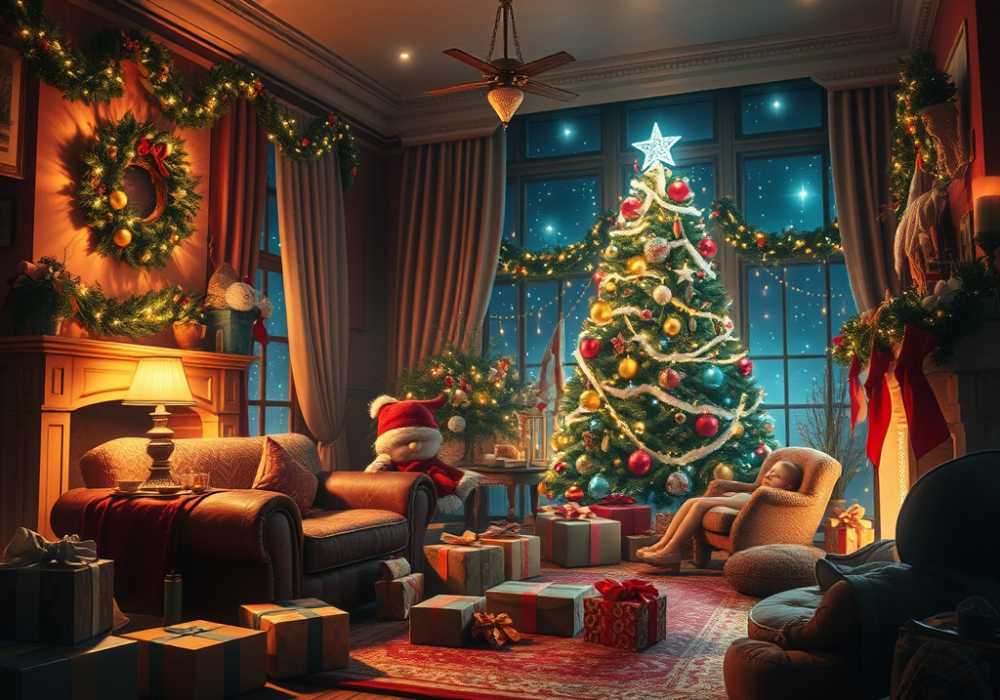
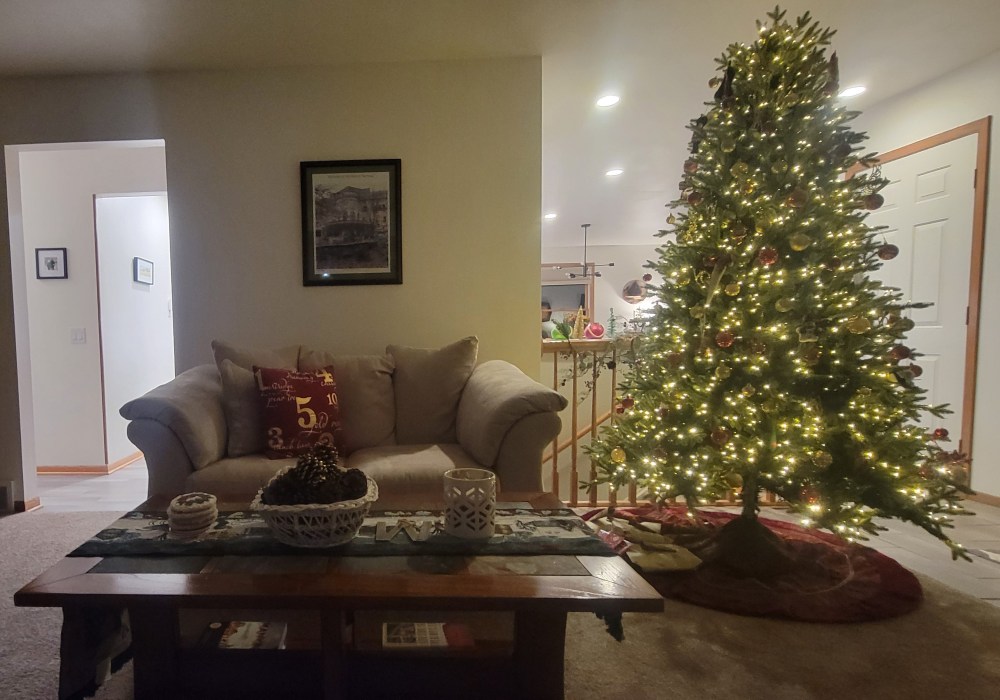
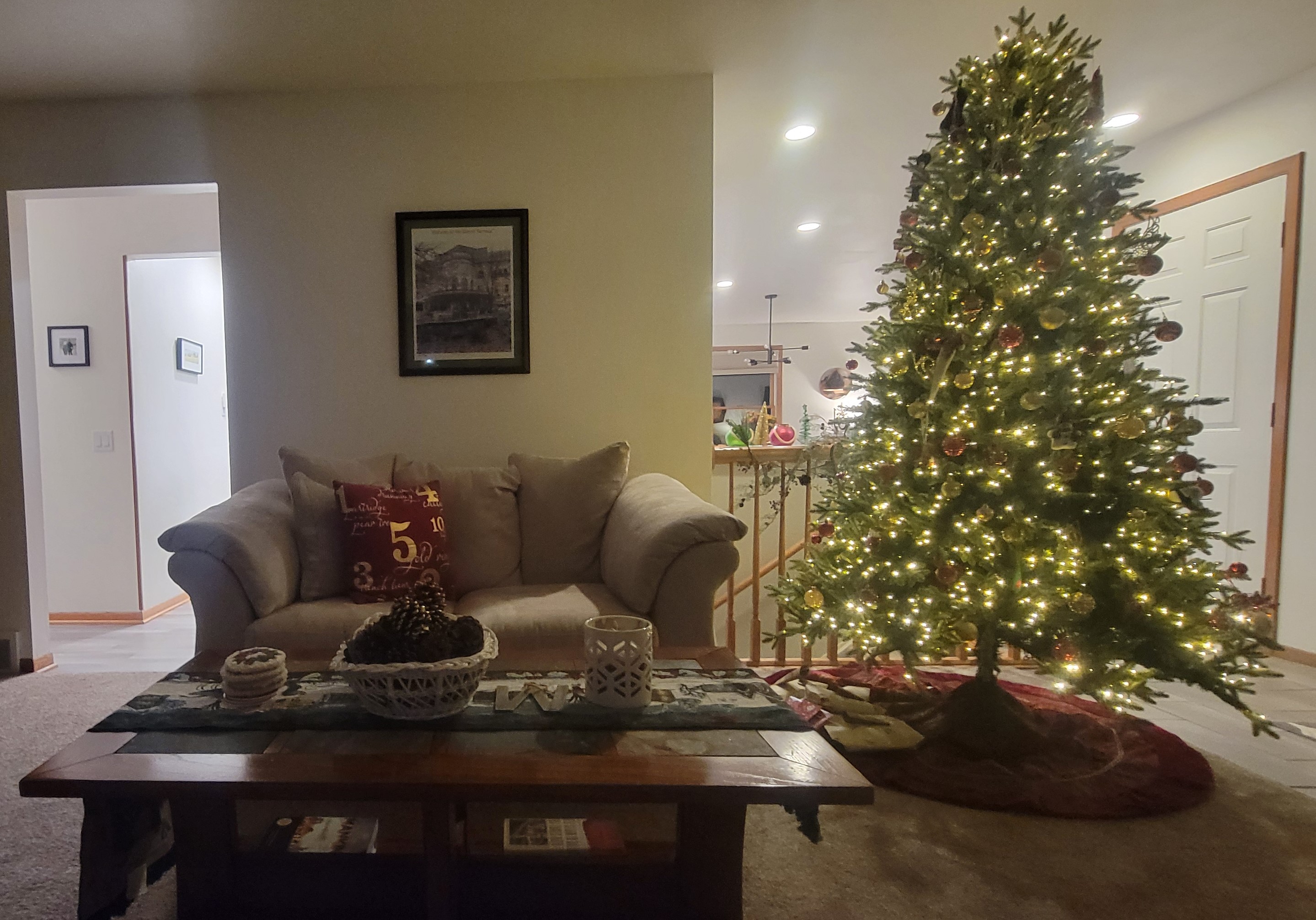
Baby, Please Come Home for Christmas is playing in the background. I can hear my wife singing upstairs as she puts the finishing touches on her Christmas decorations. The Christmas trees are all up and decorating our home, yes, that’s Christmas trees plural. And thanks to our talented elf, aka my wife Deb, every room is resiliently staged in its own Christmas theme. Christmas lights are bedazzling my front yard, sans an inflatable Santa, one has to draw a line somewhere. And, there is snow in the forecast. It’s still a month away, but I am ready for Christmas. To be perfectly honest, I may have started counting down the days on December 26th a year ago. Who can deny that Christmas is simply the best time of the year, unless of course you’re the Grinch.
Christmas is a time of traditions. It’s a time for memories and for memories made. It’s a time for snowmen and snowballs, warm drinks by the fire, hot chocolate, and holding hands. It’s a time for inspiration, for sharing, and love. Christmas is that time of year when everyone is just a little more compassionate. Just a little more aware of the people around them. Just a little more generous with their time and their treasures. Just a little more than they might have been the rest of the year.
Christmas is a season of rebirth for me and when I say that, I mean literally a rebirth. I am once again young, if not in body, at least in spirit. It is at Christmas that I get to be playful. My grandchildren make sure of that. They get the toys, I get to play. I can’t wait to see what Jackson, Adela, Faye, and I get this Christmas. I am sure we will enjoy it. This Christmas Day the room will be covered in wrapping paper, ribbon, and bows. The walls will echo with sounds of glee, and we will smother each other with hugs. I ask again, how can one deny that Christmas isn’t the happiest season of the year?
Unfortunately, this is not true for everyone. There are families who live with need. Families with no gifts under the tree. Families not knowing for certain where their next meal will come from. For those families, Christmas will only be a reminder of the happiness they can’t find. This leads me back to what Christmas is and should be, the chance for sharing. My wife and I have been blessed. Our children and grandchildren enjoy good health. Deb and I enjoy our health as well. We have the financial ability to take care of our needs and to practice generosity. This year, just as we always do, we will pick the charities for our giving. Our children and grandchildren will also get to pick and the chance to tell us why. When we do this, we experience the true happiness of Christmas.
Each person has the right to celebrate Christmas in their own manner. I choose to celebrate Christmas with friends and family. I choose to celebrate it in the spirit of sharing and giving. I will sing along with every Christmas song they play before they stop playing them. I accept the challenge to share a smile with everyone I see and a hug with anyone that needs one. And I will tell you once again, Christmas is the best time of the year. At least it is for me.
The election is behind us, and I would be lying if I didn’t say I was disappointed in the outcome. For those who know me, that won’t be much of a surprise. I just returned from interviewing a volunteer. We talked about the importance of making connections and building relationships. I couldn’t help but think about the irony of elections. Both parties stress how important is to get rid of the divisiveness that divides us as a nation. They each tell us how they will be the one to heal the nation and bridge that divide. To me, the idea of party politics is just the opposite. In elections we are asked to pick between two candidates. Whether you choose A or B, you have chosen a side and that generally deepens the divide. Our elections seem to come out near 50:50. This speaks volumes to the fact that as a populace, we are more undecided than we admit. If we really want to heal our divide, it won’t come from our elected officials. After all, they are bound to their party affiliate, and that is what divides us.
My wife and I recently attended an impromptu block party in a neighbor’s driveway. This neighbor had wanted the two newest homeowners on our block to have a chance to meet their neighbors. She had gone door to door and invited everyone on our block to come to her party. I expected a handful of them to seize the opportunity, but to our amazement, everyone showed up. The term neighbor implies someone in proximity and undoubtedly someone you know, maybe even friends with. Even though we had lived on this block for thirty plus years, we met people we had never known. That night we shared stories, the stories, of how we had come to live in this neighborhood; our neighborhood. We shared our phone numbers and our emails. We became neighbors who knew each other.
There is a point here. For those of you who have been readers of my blog, you know that there is always a point. Throughout that evening, we never talked about our politics. That would have divided us. We talked about our families, our kids, and our grandkids. We shared pictures and stories. We talked about life. If we are to heal the divide in this nation, it will start at gatherings like this. We heal through our interactions with each other. We heal as a nation when we rely more on each other and less on our politicians. They have the power to legislate, it’s what we gave them when we elected them. We have the power to set policy, we do it through public opinion. If we are going to close this divide. If we are to heal, it starts by first putting aside our differences and instead, accentuating our commonalities. Let’s realize that we are all neighbors who need to get to know each other. Let’s throw a block party for the nation, no judgments, no choosing sides, just conversations. I’ll invite you; you invite your neighbor. Welcome to the party, let me introduce you to the neighbors!
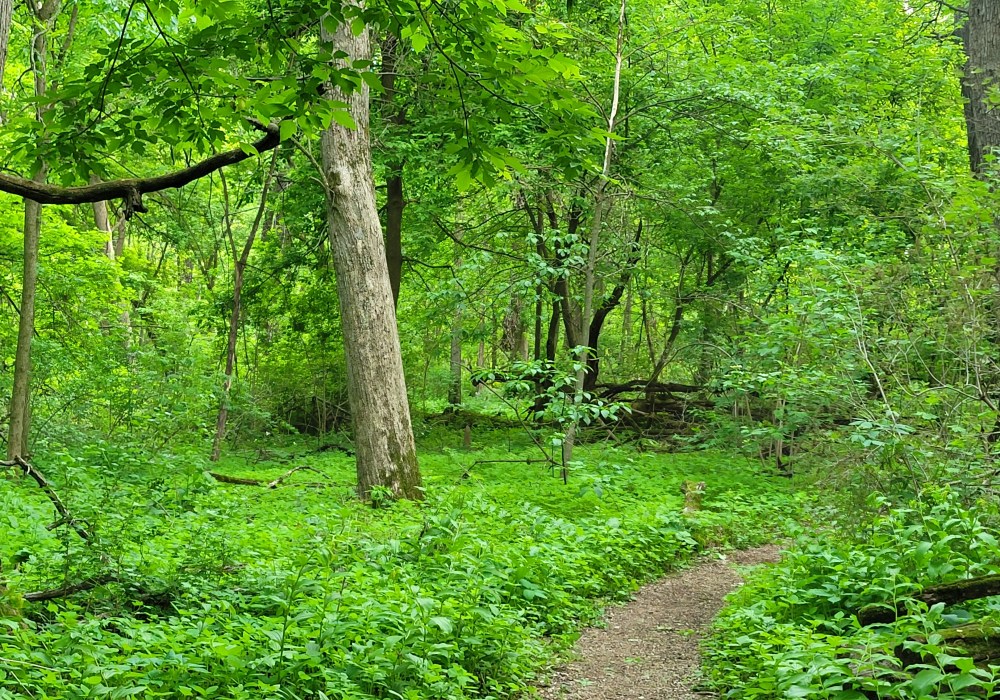
Last week as I was hiking with my grandkids on our favorite trail, I couldn’t help but make several observations. The first of these observations was that at my age I should know better than to think I can match the energy of a seven-year-old and a ten year old. To my surprise though, I came in a close second. As they explored and climbed and ran; I watched, and admired, and jogged. And except for their sprint to the finish line as they neared the end of the trail, I was there with them.
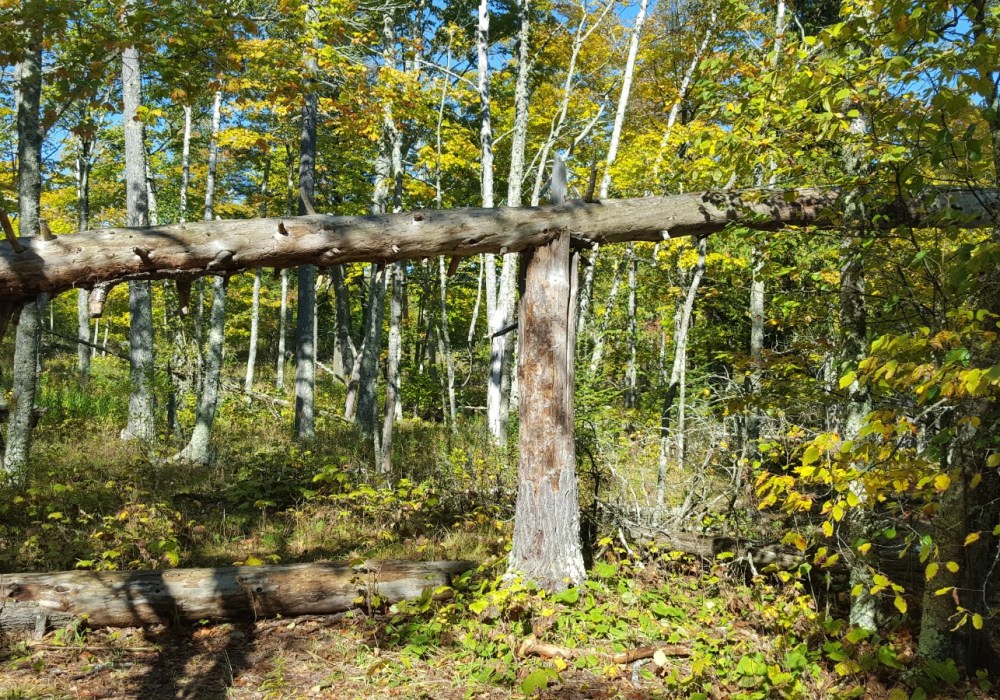
My second observation involved the trees. As I followed the trail through dense groves of cedars, maples, and oak trees stretching up from the forest floor, reaching to find the sun, it became clear that some of those trees had failed in their effort to survive. Some had succumbed to age while others had been pushed down by the fierce winds of a storm. While destined to crash to the ground, there were those whose fall had been arrested by a neighboring tree. Those trees hung suspended midway between their captor and the forest floor below. It was as if those trees refused to let one of their own give in to its fate.
As I walked, I thought about how people can be like those trees. We too can be knocked down. We too can fall. Sometimes it is life itself that knocks us down, but other times we might be pushed down by the very society that should be lifting us up. It might be another person who pushes us down, or maybe it’s an entire group of people that chose to push us down or hold us back. What can we as a society do to stop their fall? How do we catch them, or do we simply let them fall? It is said that until we fall, we cannot learn to rise, but is it their destiny that we let them fall, or our responsibility to be there when they cannot rise on their own?
We are in a very divisive political time. As we face this election, we have a choice, the choice to vote from our pocketbook or from our heart; to vote to protect our wealth or vote to protect our society. We get to make the choice. Will we offer a branch to catch the falling tree, or will we let it fall? We are that grove of trees, a society that whether we like it or not, depends on each one of its members to keep that society strong. The issues our society faces are numerous; our culture, our rights, our climate, our security, and our livelihoods. As you go to the polls, and I hope you do, consider the importance of these issues and then cast your vote to protect them. Let’s not be the one to just let the tree fall.
It’s been a while since I sat down and wrote in my blog. It’s not because I was lazy or distracted, although that might have been part of the reason, it is just hard sometimes for me to find a topic that feels right. I have started multiple pieces only to have them end mid-sentence with no place to go. For me, if the topic is right, the piece finds its own ending.
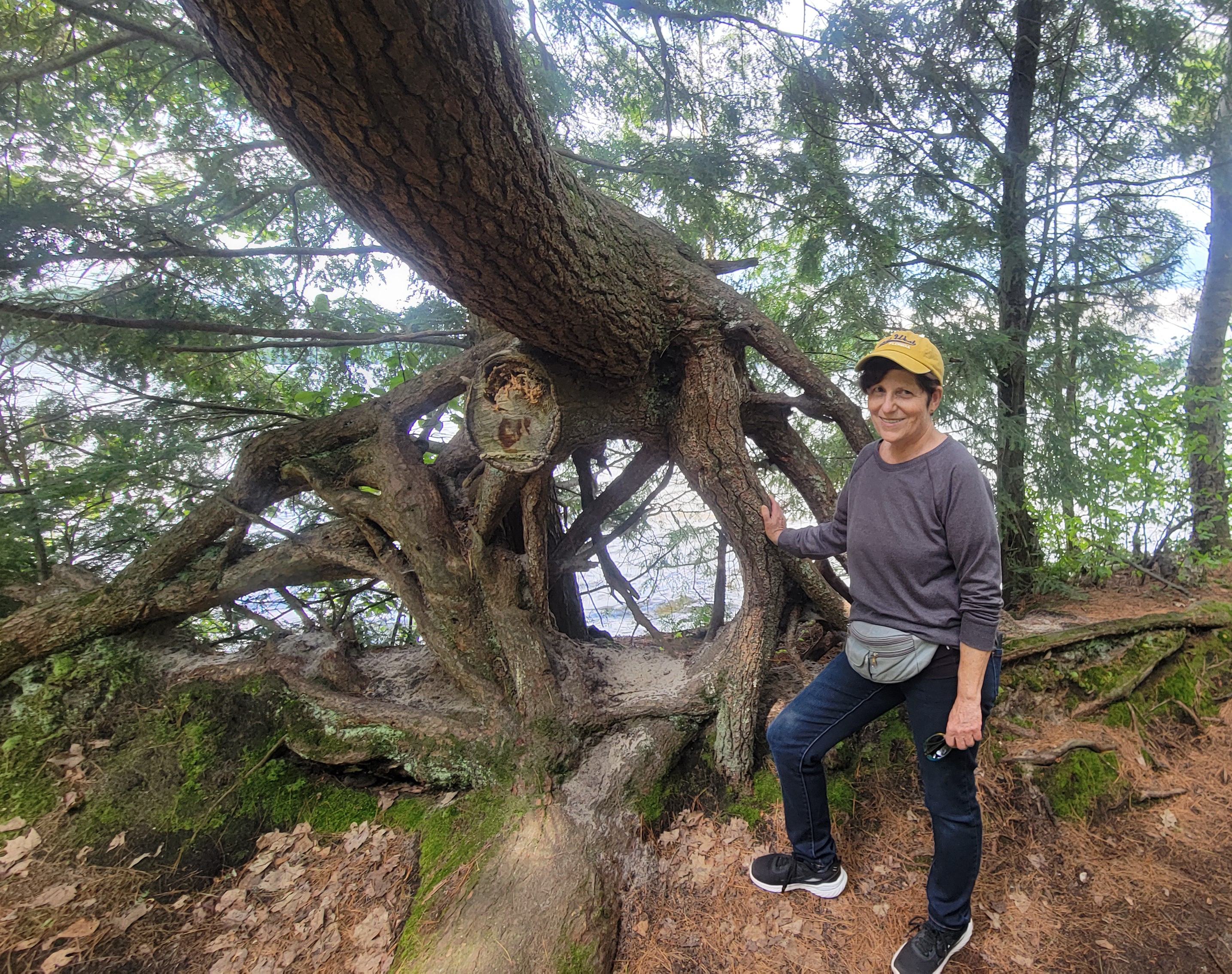
I just returned from a hike with my grandchildren, Jackson and Adela. We had chosen one of our favorite trails, whose location we keep secret. If we didn’t, the solitude it offers would be diminished by the hordes of people it might attract, the crunch of pine needles beneath our feet would be replaced with the sound of a hundred other feet. For us the two-mile loop trail offers majestic lake views on our left and beautiful stands of hardwoods, evergreens and cypress groves on our right, and all along the trail, the solitude that comes with the deep green forest. As we follow the trail, it meanders past several rock and forest formations which my grandchildren have taken the effort to name. Queens Chair and King’s chair, one formed from a long ago fallen tree stump and the other from a perfectly formed boulder, Hotel Rock, a boulder big enough to scale as they always do, the Black Lagoon and Spit Bridge, don’t even ask but the sign says slippery when wet, are just a few of the names they have chosen. But of the many interesting formations are two trees, The Knotted Tree and the Resilient Tree.
The Knotted Tree is a cypress that at some time in its growth cycle, through an act of nature, found itself forced to grow around itself with the result being this tree that appears tied in a knot. The Resilient Tree faced a similar problem. At some point it had been blown down, likely by a heavy storm. Lying on the ground, stretched across the trail, with its roots turned up to the sky, it decided to survive. The tree began to grow upward from its roots at one end and the end of the trunk from the other. At one point, though recently trimmed to clear the trail, it had actually shot out a new limb that crossed the trail above its fallen trunk. It was upon passing these two examples of survival and adaptation, that the inspiration for this piece sprung forth.
We are currently in an unprecedented period of history. There is enough divisiveness and political rhetoric to grind even the most optimistic of us to despair. We are facing factions on both sides that see our way of life at peril if the other side wins. In this setting, it is too easy to just give up or at the very least give in. When I looked at those two trees today, I saw a metaphor for life. We can be knocked down. We can even choose to give up, but that is not what it means to live. We as humans have an incredible ability to adapt to new situations, to rebound from failure, to pick our way through the maze of issues, to continue to find a way forward. It is clique to say that every cloud has a silver lining, because sometimes they just don’t, but to give up is to choose not to live. Just like both of those trees, we can find a way to survive and even to thrive no matter what the storm that might try to shake us to our core.
Come this November we will be asked to voice our opinion as a nation, and we will do that with our vote. If we are to give into our fears, it we find ourselves pushed to the brink of cynicism, to a point where we decide to give up our right to vote, then we will be forced to live with the outcome regardless of our beliefs. If we choose instead to vote our conscience, then no matter the outcome, our voice will at least have been heard. Then like those two trees that, by persistence and resilience, found a way to survive, we too may find a way to adapt and even to thrive.
Almost from the day my daughter and I made plans to be directly in the path of totality for the solar eclipse that was set to occur during the afternoon hours of April 8th, our nervousness began. At first, it was a long way off and though we hadn’t spent much time considering the weather, it had crossed our mind. But, Bailey and I being Bailey and I, we plowed ahead with our sketchy plans and booked hotel rooms for the entire family in St Louis. It had started out as Bailey and I but we had been so convincing in our enthusiasm that both of my daughters families would be coming as well. We committed to being optimistic and would worry about the weather when it came time to leave.
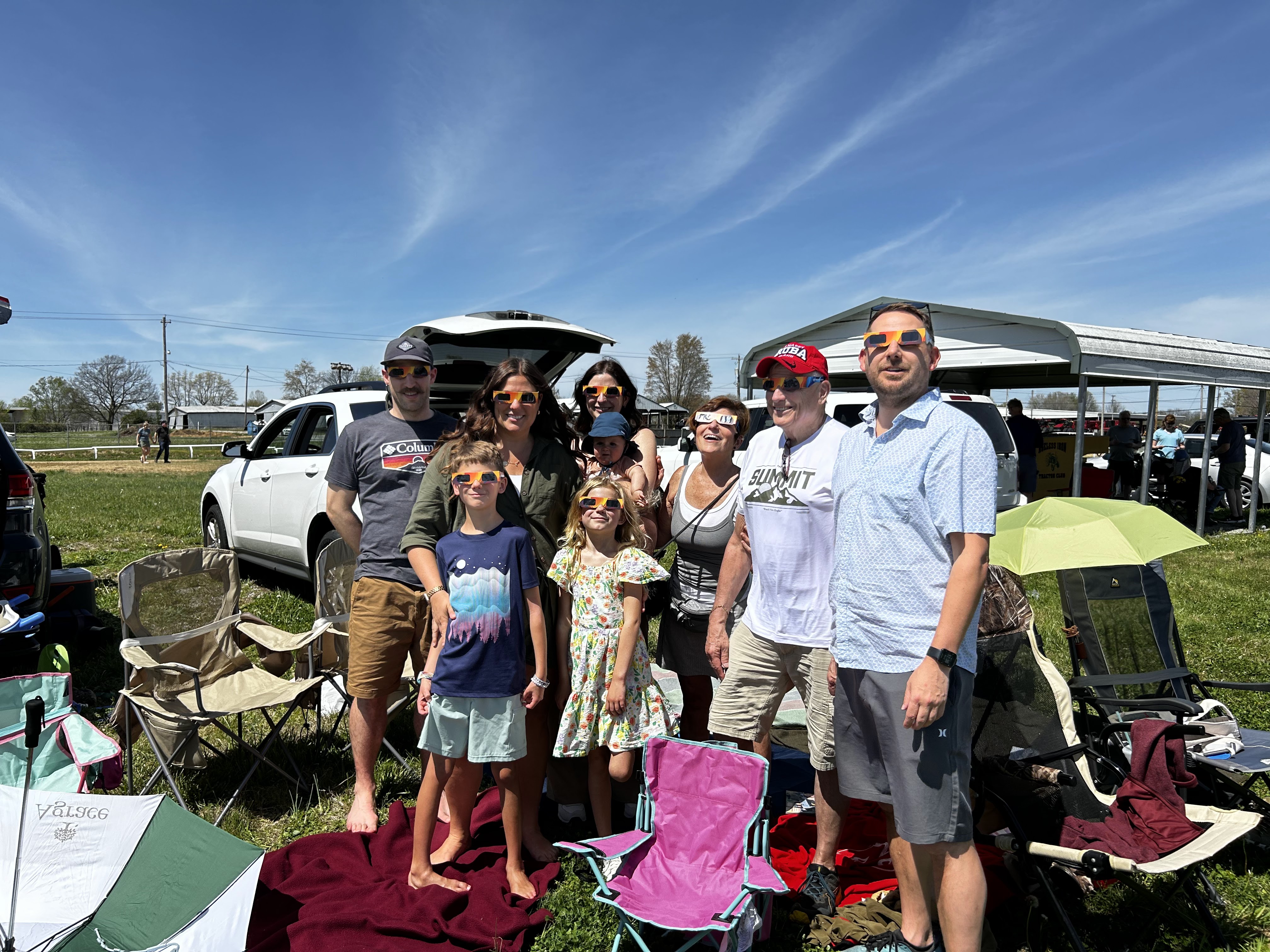
Soon the eclipse was less than a month off, and the spring weather in the eclipse’s path was not looking good. Every day, we would check multiple weather apps, willing the skies to clear despite the still pessimistic reports. As the weekend approached, there was a glimmer of hope for at least a hazy view. We buoyed our spirits and headed for St. Louis, nine of us in two cars ranging in age from 10 months to, well, my age. We explored St Louis that Saturday and Sunday and then on Monday morning we took off. In Bailey and my original plan, we would have simply chased the path until we found a place to plant ourself under the eclipse, but I had my two son-in-laws along and they could not and would not accept our impulsiveness. With the assistance of Google Maps and the internet, John pinned down our optimum viewing site. Lying dead center on the eclipses path, he had settled on McLeansboro, Illinois. All we needed now was for the clouds to dissipate and then steer clear for the two hours of the event. All our worrying would be settled, one way or the other we were headed to the eclipse. We rolled into town two hours before the eclipse was to begin and after parking in a large fairground, began hauling out the blankets and lawn chairs and prepared ourselves for the astronomical show to begin.
There is something uniquely special about viewing an eclipse, and when you have been fortunate enough, or determined enough, to get directly in the path of totality, it begins the minute you set up. Unless you were viewing it alone, no problem with that, you find yourself in the midst of a crowd of people who are immediately bonding with you over the common quest to be part of something special. You are an “eclipser” and now indoctrinated into your larger family of like minded, spirited, individuals. “Where are you from?” “How far have you traveled?” “Is this your first eclipse?” In the case of my daughters, wife and I, this would be our second. eclipse. We did have two of our grandchildren with us that first time, but at 4 months and three years old, they really didn’t remember anything. Jackson, now ten, states that what ever memories he has are probably the result of all the stories that have been told and retold about that first one. The fact that this would be our second eclipse, elevates us to our new status of eclipse chasers. We get to compare eclipses and talk about where we saw our first one. At this point, with an hour to go before the initial stages of the eclipse, the excitement level is rising. With each passing minute, more cars and their occupants are joining the crowd.
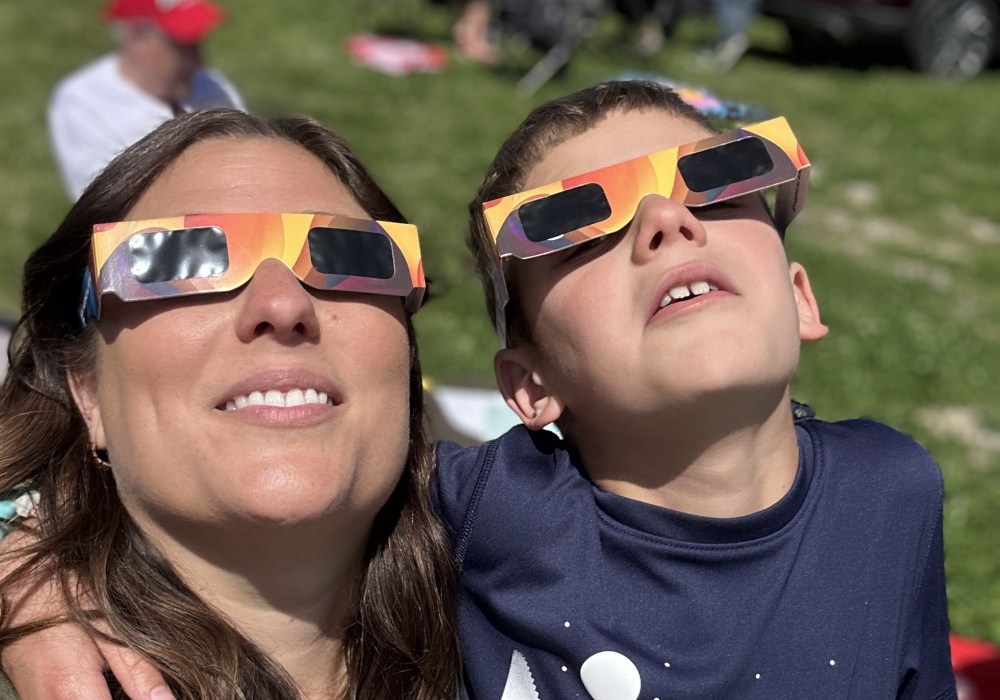
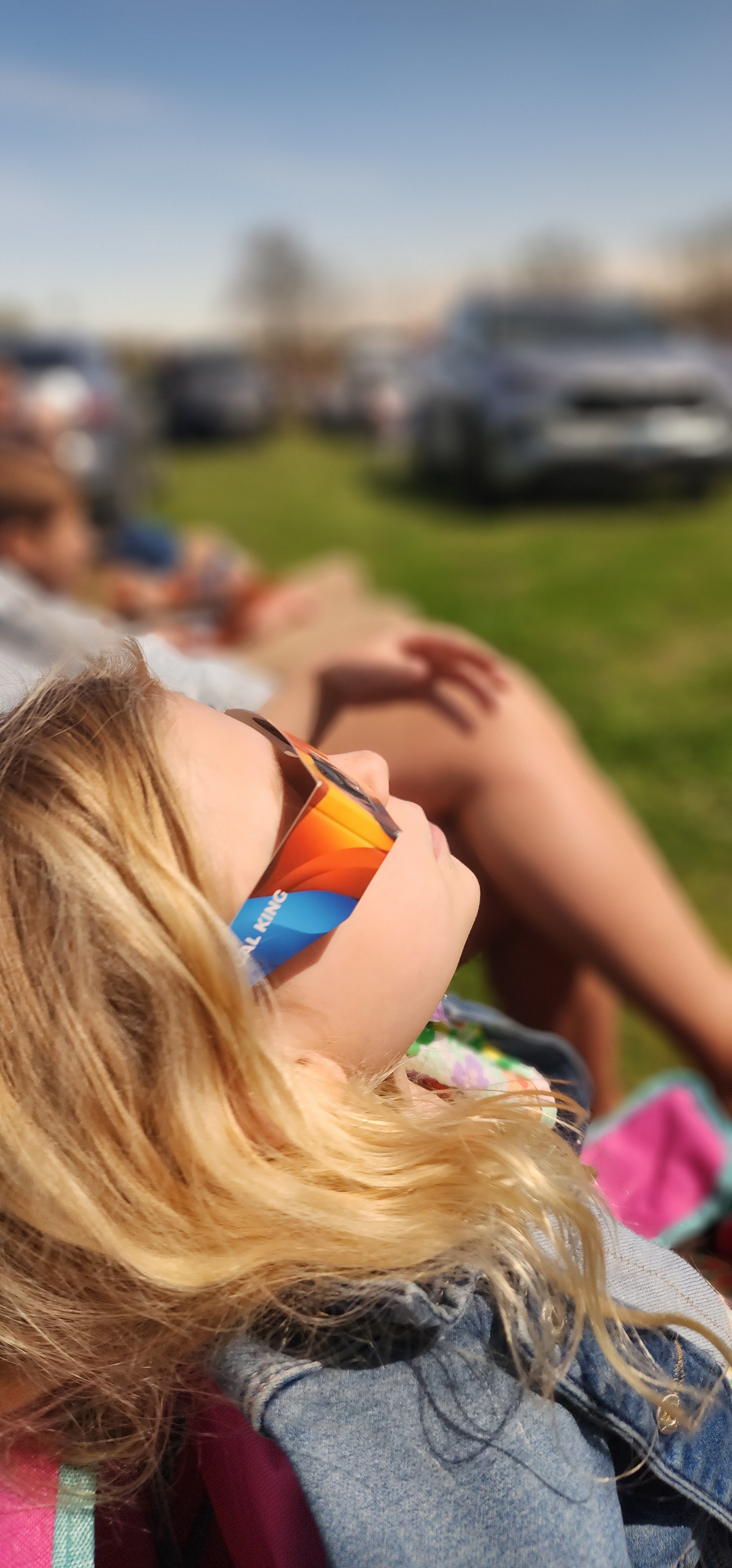
It is 12:54 pm CST and the moon begins its slow and steady transit across the face of the sun. The eclipse has officially begun. We don our eclipse glasses and begin checking on the progress every 5 minutes or so. We begin reminding Jackson and Adela to always put on their glasses when checking progress and when I glance over at Faye, nestled in her dad’s lap, she too has her glasses on.
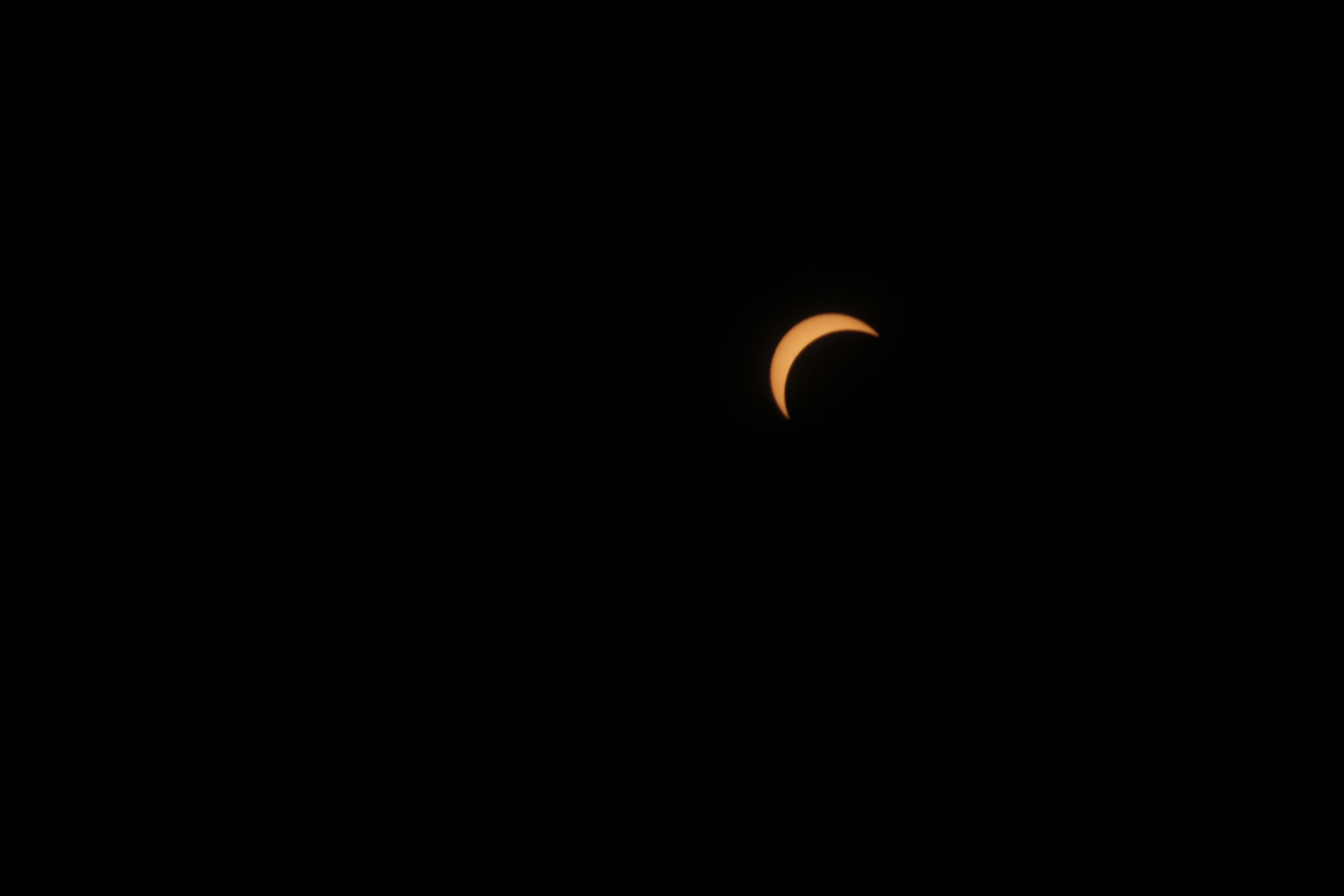
Eventually the sun is being reduced to a crescent and we are now checking on it regularly. As the hour approaches 2:00, the sky becomes a deepening shade, not dusk, not dark, but rather an almost eerie shadowing that defies my attempt to adequately describe it. The next thing we notice, is the breeze. As the sky begins to darken, and as the air cools, a light breeze descends. The sun, as it eclipses is creating a 360 degree sunset effect. Birds are heading to the trees, confused by what is happening. If the air and the sky is right, you can actually see shadows move across the surface of moon as it slides across the sun, and though we had worried about the clouds or perhaps because we did, the clouds cleared and we are granted perfect viewing conditions.
Suddenly, everyone is on their feet and with 10 seconds to go before totality, the countdown begins. Several hundred people, now family, begin counting it down. As we reach zero, as if the moon and sun heard us, totality! Our eclipse glasses come off and the first thing we see is the corona. It explodes all around the rim of the sun and it takes your breath away. As we look on, we are reminded just how small we are and at the same time, how unique. We can clearly see the beads, as they are called, seeming to move along the edge of the moon, an effect created by rays of the sun shining between the mountains of the moon. No words can come close to describing what you are seeing or what you are feeling. Many of the people I talked to, said they openly wept.
It was at this point something strange happened to me. I should be staring at the eclipse, relishing every second of the four minutes and eight seconds of totality, but instead, after a few seconds of looking up, I looked over. There was my ten year old grandson Jackson and my seven year old granddaughter Adela, leaping out of their lawn chairs, jumping up and down, and shrieking with what can only be described as shear joy. Jackson is screaming, “Holy moly, holy moly! There’s the corona, I can see the corona, and there are the beads and the diamond!!!!”
I savored that moment and then turned my eyes back to the eclipse, staring in awe for the next four minutes. And then it is over. The sun begins to reclaim the sky. I don’t think I will ever know which visual will be the more indelible memory, the total eclipse, or that moment of shear joy I witnessed in my grandchildren. Had I not taken that second to look over at them, I could have missed the priceless moment that made the entire trip, the distance, the time, and the cost all worth it.
We often miss the great opportunities in life because we wouldn’t take the time, we wouldn’t put in the effort, or we just looked the wrong way. The eclipse took my breath away and the image will stay burned in my memory, I will talk about it forever and to whomever would listen, but just as lasting will be the memory of the joy and wonder I saw through my grandchildren’s eyes that April 8th afternoon.
In case you are wondering, next eclipse, 2026 across Spain. I think Jackson and Adela should see Europe and catch a few corona rays. Dear God, I AM an eclipse chaser!!
We recently took a trip with our two daughters and their families on our quest to see the total eclipse, which we successfully accomplished. But more detail on that in a forth coming blog. We spent the first two days in St. Louis, where on our first evening there saw something that had my 7 year-old granddaughter’s face glued to the window of our hotel. Just outside the window stood a horse and carriage. The carriage was decked out in flowers and simply screamed Cinderella to my princess granddaughter, Adela.
As I watched her eyes light up at seeing that carriage, I knew she needed a prince charming. In that moment, I decided it should be me. I took her hand and asked if she’d like to go outside to see it close up. She grabbed my hand and bolted for the door. As we got out to the street and Adela became engrossed with the whole image before her, I quickly and quietly negotiated the price with the driver. What happened next was totally worth the cost of the ride. I took Adela’s hand and asked if she would like to step into her carriage? “Seriously, Opa?” “Seriously, Adela!”
We brought her mom and brother along on our ride, as well as my own princess bride, Deb, and for the next half hour, we rode through downtown St. Louis, but Adela was the star. Her smile lit up her face and her eyes twinkled. If I could have read her mind, I suspect it was savoring the fairy tale she now found herself part of. I’m not sure who received the greater gift, Adela by getting the ride, or me for getting to be her hero. Even though the ride was over before we knew it, the retelling of it lasted well into the evening.
So, how do you make a princess smile? You get her a carriage and be her prince charming.
We were recently in Aruba with another couple for a week of sun, warmth, and relaxation. I had been given the task of securing our cabana on the beach each morning. Due to the popularity of our beach, you needed to be there by 6:30 in the morning if you were to get one of the much sought after cabanas. This was an easily accepted task for me as I tend to have a hard time sleeping past 6:00 anyway. For the first three days, I arrived right around 6:30 am and along with the other early cabana claimers, would find an open one, plant a coupe of stake holder chairs with towels, and then head back to the condo where by this time, everyone was up and moving.
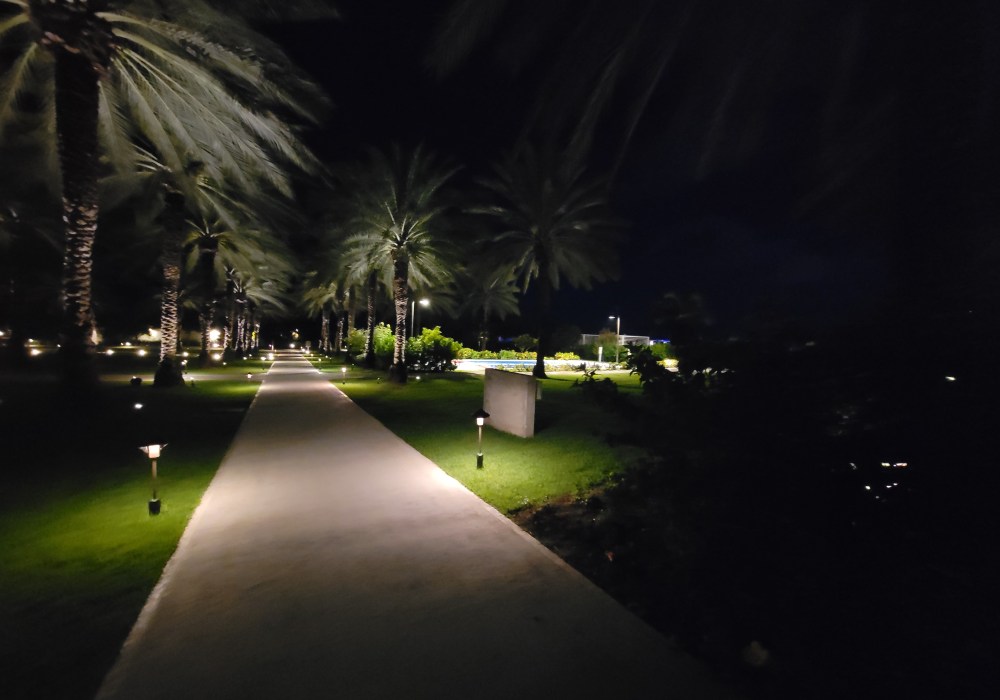
For our last day on Aruba, we were undecided as to whether we would spend our last hours on the beach, or use them to grab a little last sight seeing. For reasons unknown to me, I awoke just before five am that morning, and lying awake next to my sleepy spouse, decided I would take our chairs and head down to the beach earlier than usual to claim a spot on the off hand chance that beach time would win out over sight seeing. As I stepped out onto the street that separated our condo from the beach, I couldn’t help but noticed the stillness of the predawn hour. Save for the waves lapping the beach, there were no other sounds. The city was still asleep. Where the morning before there had been a fewer runners and an occasional vehicle, this morning it was too early even for that. I was alone.
At face value, loneliness is not generally a welcome companion, but this loneliness had such a different feel. I wasn’t lonely, I was simply alone. The beach, softly backlit by the street lamps of the empty boulevard behind me, was deserted at this hour. Having staked out my claim, I began to walk the water’s edge as the ocean crept up the sand beach and lapped at my feet. Realizing that going back to the condo would be too early for my sleeping roommates, I decided to enjoy my alone time. I headed back up the beach and out to the silent street. I decided to walk the ocean front, soaking in the quiet of the city. As I walked, I eventually found myself at a small diner, the only open business along my entire walk. The thought of a hot cup of joe in this cozy diner suddenly was very appealing. As I entered, I found myself as the only other patron in the diner. At that point, had there been even a small crowd, I am sure I would have left, but as it was just the two of us and the waitress, I grabbed a seat. By the time my coffee came, I had struck up a conversation with my fellow diner, revealing where we were from and what had found us here so early in the morning.
With my coffee consumed and the sun just beginning to push back the darkness, I began my walk back to the condo. Unlike my walk to the diner in a city still asleep, she was now beginning to stir. Cars were starting to frequent the street, runners were emerging from beachfront condos, and the sounds of the city began to push back the silence. A building crane over here and a truck over there each adding there sounds to the growing noise of a waking city. By the time I reached the condo, the sun was climbing out of the ocean and sunlight began to replace streetlights. My alone time was ending.
Though there doesn’t need to be a point to story telling, there is a point to this one. I write it to preserve the beautiful memory of that morning and to share the image with whoever has experienced something similar. We can choose to be lonely, or we can welcome the opportunity for alone time. In a world filled all too often with bad news and unwanted noise, the quiet of being alone might truly be inviting. Do understand, I do not dismiss the dangers of loneliness, for there can be danger when mixed with a sense of despair or hopelessness, but rather that sometimes the best times are those quiet times alone. In those times we avoid the distractions of life and find the ability to refocus on what is important.
For me, that early morning walk with just the quiet of the predawn morning as my companion, will be my favorite memory of our week in Aruba. The sound of the waves, the empty streets, and that cozy diner shared with a stranger were exactly what I needed. What a perfect ending to an island getaway. It was the relaxing last moment before I would deal with the cacophony of the world awaiting me back home. It had reminded me that I had the ability to push out the noise and refocus my thoughts. Here’s hoping you can savor your next alone time, and that like I did that morning, you can find the beauty in the quiet that surrounds you.
The clock says its 1:30 am. As I have done each night for the past three weeks, I nodded off just before midnight, only to have my slumber cut short, coming full awake sometime around 1:00 am. This has been my pattern every night since the surgery. Once I reawake, the battle to regain sleep begins. I switch my positions from the easy chair, to the couch, and then back to the chair. It would seem logical that I should be in my own bed, but early on in the process, that bed reminded me that I wasn’t welcome there. The sling I am imprisoned in, along with its four inch attached block, refuses to let me lie with any kind of comfort in or on a bed. Just another cruel twist to this game.
I have never been one to require much sleep. Six hours is almost too long while five hours has always been sufficient, provided it isn’t interrupted on those occasions when insomnia takes over the controls. Insomnia is a strange beast. On one hand, it is a cruel game of cat and mouse as I search for sleep, while on the other hand, it can open a world of quiet solitude when I give in to it. And tonight, I have given into it.
There is a kind of enveloping calm that exists if I stop fighting the insomnia and accept it as my companion for the night. At the onset all I seem to notice is the dark, but as my eyes adjust to the darkness, I begin to see a world of shadows and in those shadows, familiar objects become unfamiliar. What looked like a person crouched in the corner, turns out to be the easy chair disguised by the shadows. As time begins to elapse, its the quiet that strikes me next. The daytime sounds, footsteps and doors opening and closing, the TV chatter and the clatter of kitchen noises, the hum of the refrigerator and the occasional ding of an appliance are all gone now in the darkness of night. But even as this quiet surrounds me, I hear the sounds that only belong to the night. A rafter, stretched in the heat of the day, now contracts in the cooler night air and lets out a creaking sound as it does so. The furnace issues a pop as it switches off and the heat duct cools. There is a silence of night, but the house isn’t silent.
I’ve given in fully now. I am not going to get sleep by demanding it, but rather by letting it catch up to me. And so I take to the night. Sometimes I walk through the unoccupied rooms of the house letting my mind see the path I must take to avoid objects hiding in the shadows that will stub a toe or hit a shin. I will stop by the window and gaze out at the houses and street all enveloped in darkness save for a streetlight or a porch light here or there. When the moon is full, I will stare in awe at the moon shadows. Tonight I am sitting here typing this piece, enjoying those sounds and shadows of the night. I know that sleep will eventually catch up to me and I will hopefully squeeze in a few hours before dawn brings back the day, but for now, insomnia and I will share the night.
I write tonight as my way of avoiding the anxiety that would creep in if I were to just lie awake worrying about the sleep I was losing. Instead of that anxiety, I have embraced the solitude and I have used the time to adjust and release all the busyness of the day. I have decluttered my brain and resolved a few issues. Sometimes, the best result we can achieve is the fight we give into.





 kenisms